The U.S. Baby Bust Is Getting Worse. Deaths Could Surpass Births by 2034

 September 7, 2026

The U.S. Baby Bust Is Getting Worse. Birth rates have fallen roughly 35% over the last three decades, while deaths are steadily increasing as America gets older. By 2034, Reventure projects the country could reach a historic tipping point where deaths surpass births.
That would fundamentally change America’s demographic engine.
For generations, the United States benefited from a growing population of children who eventually became workers, renters, homeowners, and parents. But that pipeline is shrinking. The 2020 Census marked the first decennial census in U.S. history to record a decline in the under-18 population.
Meanwhile, America’s population aged 65 and older has roughly doubled over the last three decades.
These two trends are now converging. Fewer young Americans are moving toward their prime working and homebuying years. At the same time, millions of older homeowners are moving closer to the point when they will eventually leave their homes.
That could have enormous consequences for housing. The demographic crossover becomes much clearer when looking at births and deaths together. America’s birth rate has fallen sharply over the last three decades, while the death rate has gradually moved higher as the population ages.

That projected crossover would represent a major demographic turning point. But the shift is already visible in another important measure: the rapidly narrowing gap between America’s children and seniors.
Why the U.S. Baby Bust Is Getting Worse
Two demographic forces explain much of America’s slowdown.
First, fertility rates have declined substantially. Americans are having fewer children, which reduces the number of young people entering the population.
Second, the country is aging.
Baby Boomers continue moving into retirement, causing the 65+ population to grow rapidly. That also means deaths will naturally increase over the coming decades.
The result is a narrowing gap between births and deaths.
These demographic shifts move slowly, but their effects can last for decades. School enrollment, household formation, labor-force growth, housing demand, and eventually housing supply can all feel the impact.
Japan provides an extreme international example of what prolonged population aging and weak birth rates can produce. Demographic decline has contributed to persistent economic and housing pressures there, particularly outside its strongest population centers.
America isn’t Japan. Immigration, economic growth, geography, and housing supply differ considerably.
But the demographic direction deserves attention.
The U.S. Baby Bust Is Shrinking America’s Child Population
Perhaps the clearest evidence comes from America’s children.
The under-18 population peaked around 2007–08 and has gradually declined since then. That is an extraordinary reversal for a country accustomed to continuous population growth.
At the same time, the 65+ population continues climbing.
Back in 1985, America had more than twice as many people under 18 as people aged 65 and older. That gap has narrowed dramatically. The scale of that reversal is striking. While America’s child population has largely stagnated and recently declined, the number of Americans aged 65 and older has climbed rapidly.

For housing, these lines represent two very different forces. The shrinking younger population points toward fewer future households entering their prime buying years, while the expanding older population could eventually influence how much resale inventory returns to the market.
If current trends continue, the 65+ population could eventually overtake the under-18 population.
Housing consequences won’t appear overnight.
But today’s children represent tomorrow’s renters, first-time buyers, and growing families. A smaller generation of young people means fewer potential households entering those stages 10, 20, and 30 years from now.
That creates a structural headwind for housing demand.
Fewer Children Could Mean Fewer Future Homebuyers
Homeownership becomes particularly valuable when households start families.
Parents often need additional bedrooms, larger living spaces, yards, better schools, and greater residential stability. Those needs encourage households to move from apartments into houses or upgrade to larger properties.
Fewer children can weaken that cycle.
It can mean fewer families buying their first house. It can also mean fewer existing homeowners need to upgrade because their families aren’t expanding.
This demographic shift could already be contributing to weaker housing demand alongside today’s much more immediate affordability problems.
But demographics are also producing an unusual short-term effect on supply.
Older Americans tend to move less frequently.
As a larger share of America’s homes becomes concentrated among older owners, fewer properties may reach the resale market each year.
That can temporarily constrain inventory.
Eventually, however, that dynamic reverses.
Aging Homeowners Could Eventually Create a Supply Wave
America has never had this many older homeowners.
The share of homes owned by people aged 75 and older has climbed substantially over the last 15 years. That can suppress listings today because older homeowners generally move less frequently. Reventure data shows how quickly this shift has occurred. The share of U.S. homeowners aged 75 and older increased from roughly 11.4% in the mid-2000s to 14.3% in 2024.

For now, this aging can actually suppress inventory because older homeowners tend to move less frequently. Eventually, however, the same trend could work in reverse as downsizing, assisted living, estate transfers, and deaths gradually return more properties to the market.
But people cannot remain in their homes indefinitely.
Over time, more owners will downsize, move into assisted living, relocate closer to family, or die. Their properties will then return to the housing market.
That creates an important demographic contradiction.
America could experience fewer young buyers entering the market at the same time that more homes owned by older Americans return to it.
If that occurs at scale, certain markets could face significantly different supply-demand conditions from anything experienced during recent decades.
Florida Shows Where the U.S. Baby Bust Could Hit Hardest
Florida provides an early glimpse of this demographic challenge.
The national share of homeowners aged 75 and older is around 14%. But several Florida markets have dramatically higher concentrations.
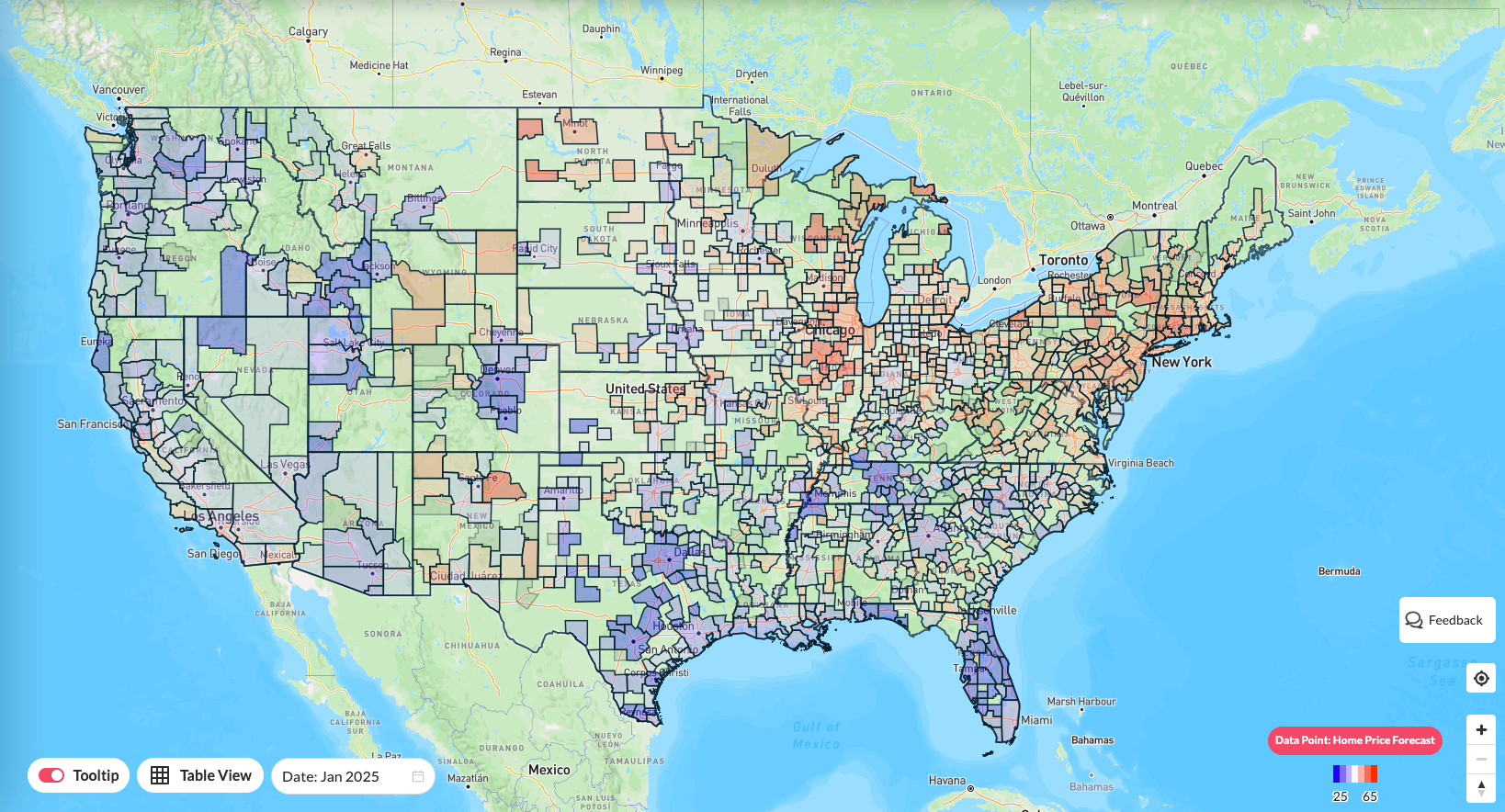
In some areas, roughly 26% to 29% of homes are already owned by people over 75. Nowhere is that concentration more visible than in Florida. Reventure’s local data shows several retirement-heavy markets where more than one-quarter of homeowners are already over age 75.

The statewide map reveals the geographic concentration, but ranking individual metros makes the demographic imbalance even more striking. Florida dominates the list of America’s oldest homeowner markets.
And among the country’s oldest homeowner markets, some Florida metros reach even higher levels. The top eight oldest homeowner metros are concentrated in the state, with elderly ownership shares ranging from roughly 23% to 40%.
In fact, the eight metros with the highest share of homeowners aged 75+ in Reventure’s ranking are all in Florida. Several also have comparatively small shares of homeowners aged 25 to 44.

That age imbalance does not guarantee falling home prices. Migration and demand from retirees can continue supporting these markets. But it does mean that a growing share of the existing housing stock is controlled by households approaching ages when housing turnover could increase.
That makes Florida an important place to watch as America’s broader demographic transition accelerates.
Those same markets generally have smaller shares of homeowners aged 25 to 44.
That imbalance matters.
Retirement destinations have always had older populations. The difference now is that America’s overall population is aging alongside them.
As these homeowners age out, Florida could experience increasing resale inventory, particularly in communities where younger buyers aren’t replacing older sellers fast enough.
Some of that adjustment may already be starting as inventory rises across parts of the state.
What Does the U.S. Baby Bust Mean for Housing?
The U.S. Baby Bust Is Getting Worse, and housing could eventually become one of the biggest areas affected.
In the short term, an aging homeowner population can actually restrict resale inventory because older owners move less frequently. But over the longer term, that same demographic trend could produce the opposite result.
Millions of homes will eventually return to the market.
Meanwhile, declining births mean fewer young Americans will age into their prime homebuying and family-forming years.
That combination could create a new housing paradigm: slower structural demand alongside rising age-related supply.
It doesn’t mean every housing market will decline.
Markets attracting younger workers, families, and immigrants could continue growing strongly. Areas dominated by aging homeowners and weak population growth could face much greater pressure.
That’s why demographics increasingly need to become part of housing analysis.
Mortgage rates and inventory tell us what is happening today.
Births, deaths, and the age of homeowners can tell us where housing demand and supply may be heading next.