

The U.S. Housing Market in Its Longest Homebuyer Recession is facing another problem that could last far longer than today’s mortgage-rate shock.
Pending home sales fell another 2.3% in July and remain roughly 33% below pre-pandemic norms. Contract signings have now stayed depressed for longer than during the entire 2008–2011 housing downturn, while mortgage applications are weakening again.
But the next housing headwind isn’t just about interest rates. It’s demographic.
Over the next decade, millions of Baby Boomers will move deeper into retirement and eventually age out of their homes. At the same time, the population entering the traditional retirement-home-buying years is already shrinking.
That combination could create a major reversal: more homes coming onto the market just as the pool of replacement buyers gets smaller.
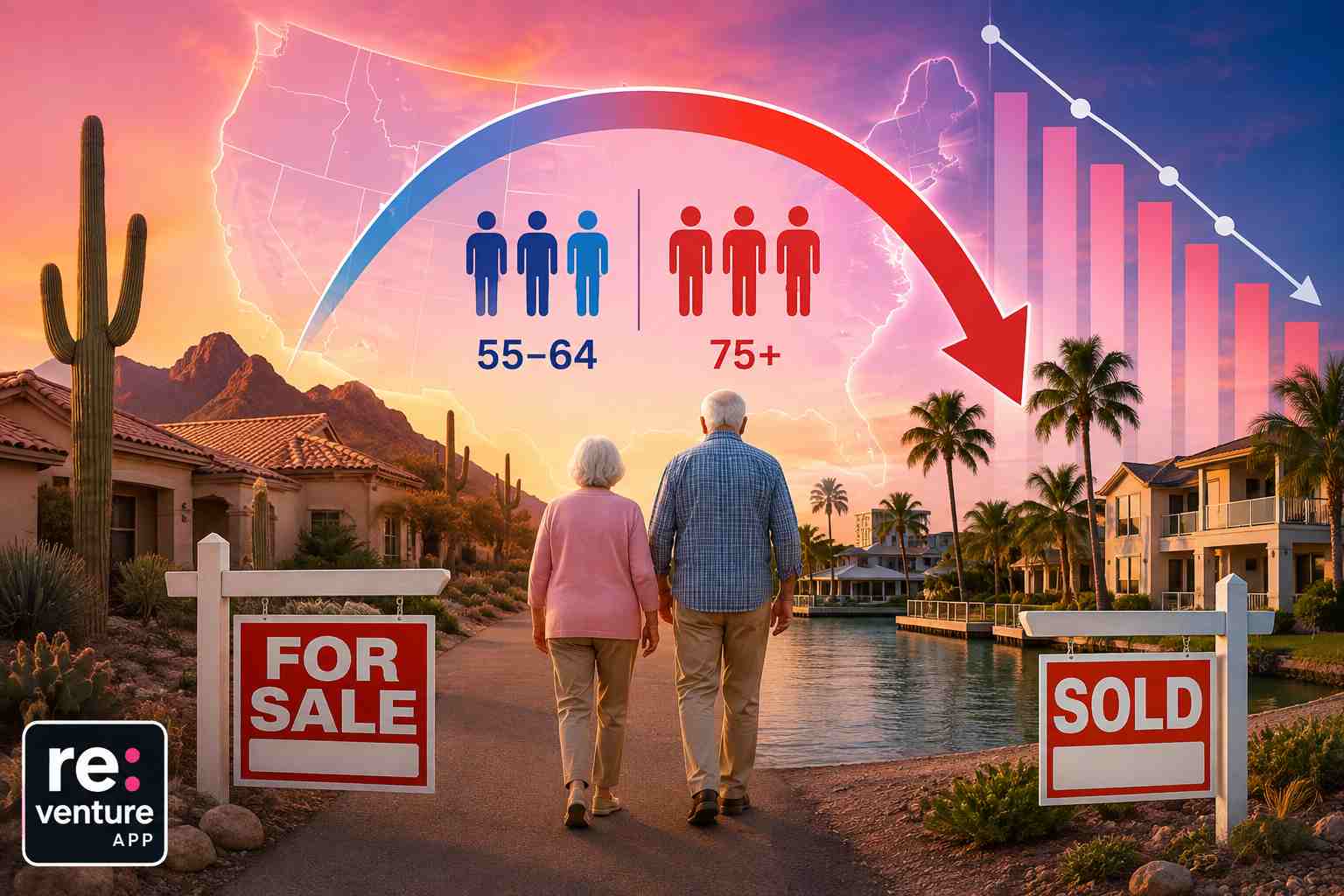
The demographic crossover behind that reversal is already visible. Reventure’s population projections show the 75+ share accelerating sharply while the 55–64 share declines, with the older group projected to overtake the younger cohort around 2037. That would mark a fundamental reversal from the demographic conditions that supported retirement housing demand for much of the last two decades.

A Demographic Shift Could Extend the U.S. Housing Market in Its Longest Homebuyer Recession
For much of the last two decades, demographics quietly provided a powerful tailwind for housing demand.
In 2000, Americans between ages of 55 and 64 represented about 8.6% of the population. By 2020, that share had surged to approximately 13.1%.
In nominal terms, the 55–64 population increased from about 24.3 million people in 2000 to 43.4 million in 2020.
That enormous demographic wave helped support retirement destinations across Florida, Arizona, and other Sun Belt markets. Millions of Americans entered their peak retirement-planning years with substantial home equity and the ability to relocate.
Now that trend is reversing.
The 55–64 population has already declined to roughly 41.2 million and is projected to continue falling over the coming decade. The nominal population figures show how dramatically these demographic waves move through the housing market. The 55–64 population surged from 24.3 million in 2000 to more than 43 million around 2020, while the 65–74 and 75+ cohorts followed approximately a decade behind. Now the early-retirement wave is rolling over just as the oldest Baby Boomer population accelerates.

That means fewer households entering an age bracket historically associated with retirement migration precisely as existing Baby Boomer homeowners get older.
Why the U.S. Housing Market in Its Longest Homebuyer Recession Faces a Double Whammy
This creates what could be described as a demographic double whammy for retirement-driven housing markets.
On one side is demand.
Gen X, which follows the Baby Boom generation, is roughly 20% smaller by population. There simply aren’t as many people moving through the same age brackets that Boomers occupied during the housing boom of the last two decades.
On the other side is supply.
The Baby Boomer population is moving steadily through the aging curve. The surge in Americans aged 55–64 began around 2000. About a decade later, the 65–74 population started climbing rapidly. Now the 75-and-older population is beginning its own sharp increase.
By 2037, there are projected to be more Americans aged 75+ than Americans aged 55–64—a demographic configuration without precedent in modern U.S. history.
For housing, that could be enormously important.
Why Baby Boomer Homes Could Return to the Market
A common argument is that Baby Boomer homes won’t necessarily become inventory because children will simply inherit them.
Available inheritance research suggests otherwise.
Estimates cited by Charles Schwab and The Wall Street Journal have suggested that a large majority of future inheritors could sell inherited homes. One Charles Schwab survey cited by The Wall Street Journal makes that potential supply pipeline particularly clear. Nearly 70% of respondents expecting to inherit their parents’ home said they planned to sell it rather than keep the property.

The reasoning is straightforward.
Separate research from Trust & Will found that 56% of surveyed people who inherited a home ultimately sold it.
And unlike the Schwab figure, which measures people’s intentions, the Trust & Will survey looked at what previous heirs actually did. Among 500 respondents who had received inherited real estate, 30% sold after at least 12 months and another 26% sold within a year.

Adult children may already own homes. They may live in another state. Others may prefer cash rather than becoming long-distance landlords responsible for maintenance, taxes and insurance.
That dynamic could be particularly important in retirement communities where heirs have little personal reason to relocate.
If even 50% to 70% of inherited properties eventually return to the market, the aging Baby Boomer population represents a potentially significant source of housing inventory over the next decade.
Florida and Arizona Face the Biggest Demographic Risk
This demographic shift won’t affect every housing market equally.
That’s why one metric we’re focusing on at Reventure is the percentage of homeowners aged 75 and older.
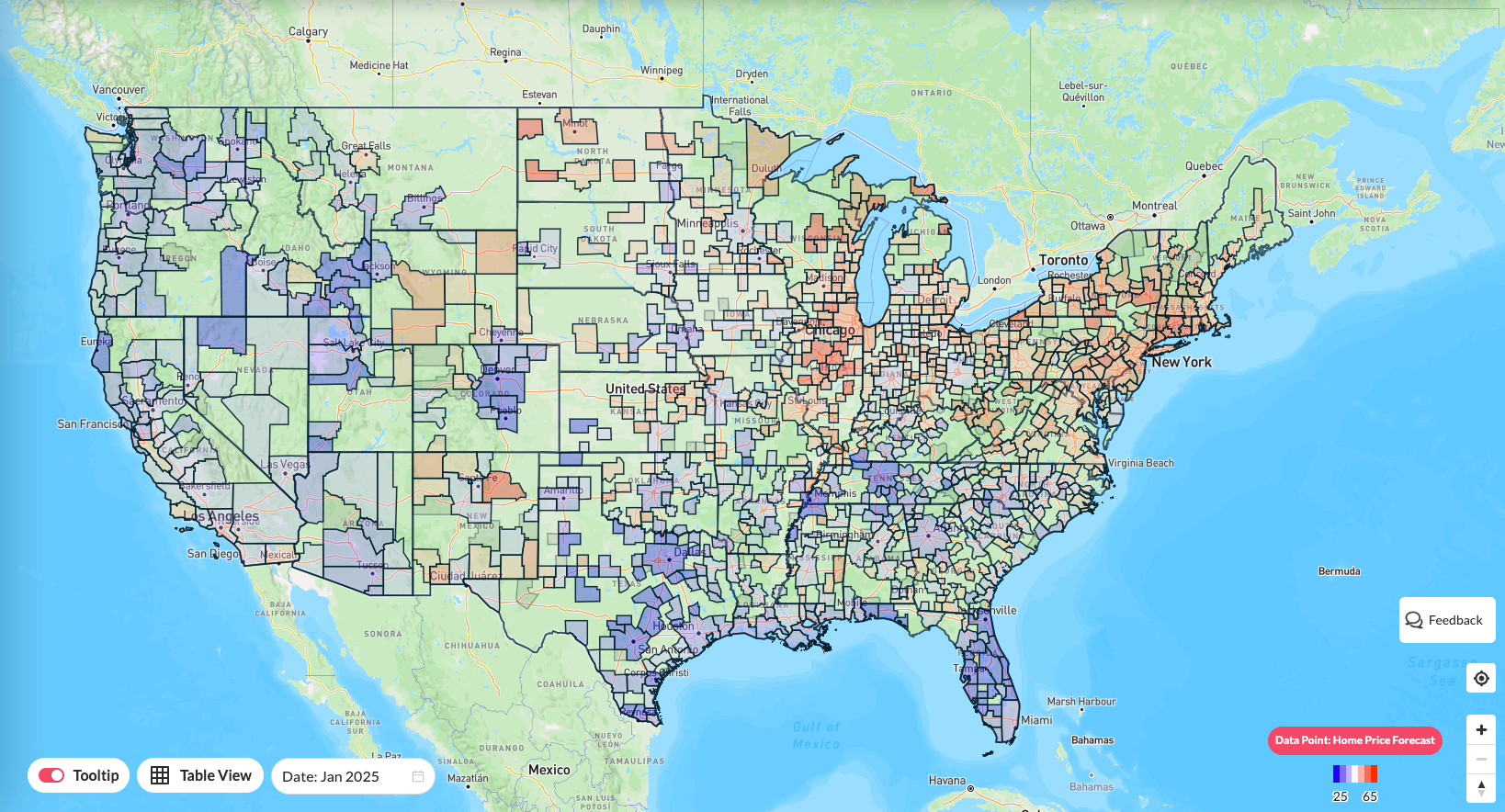
The higher that percentage becomes, the greater the potential long-term supply pressure as homeowners eventually age out. The geographic concentration is striking. Reventure data shows that older homeowners aren’t distributed evenly across the country, meaning the coming demographic transition could produce vastly different housing outcomes from one state to another.

Florida currently stands out. More than 18% of its owner-occupied homes are owned by people over 75, placing the state at the top of the country by this measure. Arizona ranks second. The ranking also reveals an interesting near-term pattern. Florida and Arizona aren’t merely the two states with the largest 75+ homeowner shares—they are also showing negative year-over-year home-value growth in this dataset.

The differences become even more dramatic locally.
Retirement-heavy Florida markets such as The Villages, Ocala, Naples, Sarasota and Punta Gorda are particularly exposed.
In Naples, approximately 29% of homeowners are over 75.

Meanwhile, Sumter County—home to The Villages—has an extraordinary 41% share of homeowners over 75. Southwest Florida shows just how concentrated the exposure becomes at the local level. Naples isn’t alone: Punta Gorda, Sebring and North Port all have exceptionally large concentrations of homeowners already over age 75
Compare that with Orange County, home to Orlando, where only about 11% of homeowners are over 75. Few comparisons illustrate the local nature of this demographic risk better. Sumter County and Orange County are both in Central Florida, yet their homeowner age profiles sit at opposite ends of the spectrum.

That suggests Orlando could be considerably less exposed to the demographic transition than Florida’s traditional retirement destinations.
Younger Homeowners Could Determine Which Markets Hold Up
The other side of the equation is the number of younger homeowners available to replace aging sellers.
Texas and parts of the Mountain West appear better positioned because they have larger concentrations of homeowners between 25 and 44. Looking at younger homeowners effectively flips the previous map. States across parts of the Mountain West and Great Plains have much larger concentrations of 25–44-year-old owners, potentially giving them a deeper pool of households that can remain in the market as older owners age out.

Florida, parts of the Northeast, the Southwest, and California have comparatively greater exposure to older homeowners in many markets.
Millennials and Gen Z could absorb some future inventory nationally, particularly if affordability improves.
But that doesn’t eliminate the regional problem.
A 30-year-old buyer looking for employment opportunities and younger demographics isn’t necessarily going to move to Sarasota simply because more homes become available there. Markets built around retirement migration still depend heavily on a steady pipeline of new retirees.
And that pipeline is shrinking.
Retirement Housing Markets Could Feel the Pressure First
Florida may already be providing an early glimpse of what happens when these demographic forces collide with weak affordability and elevated inventory.
Some of the state’s oldest homeowner markets are also experiencing significant home-price declines.
The overlap is difficult to ignore, although it shouldn’t be interpreted as proof that demographics alone caused the downturn. Several retirement-heavy markets that rank highly for older homeowners are already experiencing some of Florida’s largest declines from their pandemic-era peaks.

That doesn’t prove demographics alone caused the correction. Mortgage rates, insurance costs, property taxes, migration, and pandemic-era overvaluation are all major factors.
But demographics could make recovery harder.
Today’s cyclical housing slowdown could eventually overlap with a structural increase in listings from aging owners. If that occurs while the population of incoming retirees continues shrinking, retirement destinations could experience persistent inventory pressure rather than a typical short-lived downturn.
Demographics Could Reshape the Housing Market Through 2040
The Baby Boomer aging curve is unusually predictable.
People who were 55–64 during the housing boom of the early 2000s are becoming today’s 75+ homeowners. The 65–74 population is expected to peak around 2030, followed by the 75+ population approaching its peak around 2040.
Immigration could offset some of this demographic pressure. Millennials and Gen Z could also become stronger buyers if home prices or mortgage rates fall enough to restore affordability.
But neither outcome guarantees that demand will emerge in the same locations where Baby Boomer supply appears.
That’s why buyers and investors should increasingly examine local demographics alongside prices, inventory and mortgage rates.
Areas with fewer 75+ homeowners, more homeowners aged 25–44 and healthier birth-to-death ratios could be better positioned to withstand the demographic shift. Retirement-heavy areas with rapidly aging ownership could face the opposite scenario.
Reventure App tracks these metrics under its Demographic data section, allowing buyers and investors to compare aging trends alongside housing fundamentals at the local level. That local comparison is becoming increasingly important because national housing statistics can hide enormous demographic differences between neighboring markets. Reventure allows users to move from national trends down to state, metro, county and ZIP-code data when evaluating those risks.

That local comparison is becoming increasingly important because national housing statistics can hide enormous demographic differences between neighboring markets. Reventure allows users to move from national trends down to state, metro, county and ZIP-code data when evaluating those risks.
The current homebuyer recession may eventually end as affordability improves. But the Baby Boomer transition represents something different: a structural shift that could reshape housing supply and demand for the next decade—and Florida and Arizona may be where its effects become visible first.






2 Responses