San Francisco Home Prices Surge in 2026 While Austin Falls: How AI Is Reshaping America’s Housing Market

 July 15, 2026

San Francisco Home Prices Surge at a time when many of America’s biggest technology markets are moving in the opposite direction.
Home values in San Francisco County, CA, are up nearly 8% year over year, bidding wars have returned, and inventory has dropped sharply.
Meanwhile, neighboring Alameda and Contra Costa counties continue posting price declines, while Austin, Seattle, and Denver remain under pressure.
This growing divide tells an important story about today’s housing market.
The AI investment boom is generating enormous wealth, but those gains are concentrated in one location rather than spreading evenly across America’s technology hubs. That concentration is creating very different housing outcomes across markets that once moved together.
Instead of lifting every major tech city, the AI economy is increasingly rewarding Downtown San Francisco while leaving many other innovation centers facing rising supply and weaker home prices.
The data suggests this is becoming one of the biggest housing market stories of 2026.
San Francisco Home Prices Surge While Other Tech Markets Cool
The San Francisco Home Prices Surge is one of the most surprising developments in today’s housing market. Just a few years ago, many believed San Francisco had permanently lost its appeal following the pandemic.
Remote work, population outflows, and falling office occupancy weighed heavily on housing demand.
Today, that narrative has changed.
The explosion in artificial intelligence investment has brought new hiring, venture capital, and corporate expansion back into Downtown San Francisco, CA. Highly paid AI workers are once again competing for a limited housing supply, pushing prices higher.
Yet this recovery is remarkably localized. Neighboring counties that share many of the same economic advantages are not seeing the same results.
The contrast becomes obvious when looking across the Bay Area. While San Francisco County is experiencing rapid appreciation, nearby Alameda and Contra Costa counties continue to record annual price declines.

Why the AI Boom Is Concentrated in Downtown San Francisco, CA
Many investors assume that a booming technology sector should lift every major tech market. The latest data suggests otherwise.
The AI sector is attracting billions of dollars in venture capital, corporate investment, and startup hiring.
However, much of that activity is centered within San Francisco itself rather than spreading evenly across Silicon Valley, Seattle, Austin, or Denver.
That concentration explains why the San Francisco Home Prices Surge has become such an outlier. Housing demand is strongest where AI companies are expanding office footprints and attracting highly compensated workers.
San Francisco Is the Clear Winner
San Francisco County, CA is seeing improving conditions across nearly every housing metric. Home prices are rising, rents are climbing, vacancy rates are falling, and inventory has tightened dramatically.
Perhaps the most striking statistic is inventory. Active listings are down roughly 43% from a year ago, creating renewed competition among buyers and pushing bidding wars back into the market.
Inventory often leads price movements. When available homes decline while demand rises, prices typically respond quickly. That’s exactly what is happening inside San Francisco County.

Other Tech Markets Continue Moving in the Opposite Direction
Outside San Francisco, the picture changes dramatically. Many technology-focused counties continue to record falling home values despite benefiting from strong employment and educated workforces.
Alameda County has one of the largest home value declines among major counties in America. Those declines aren’t isolated. Many California markets continue to see significant seller discounts, as highlighted in our report on the California cities where home sellers are cutting prices the most.
Contra Costa County is also posting negative annual appreciation. Similar trends are occurring across Austin, Denver, Seattle, Raleigh, and Northern Virginia.
These regional corrections are unfolding within a much larger national affordability problem. Our analysis of the U.S. housing bubble being bigger than the 2006 housing bubble explains why more formerly booming markets are beginning to cool.
The Data Shows AI Wealth Isn’t Spreading Evenly
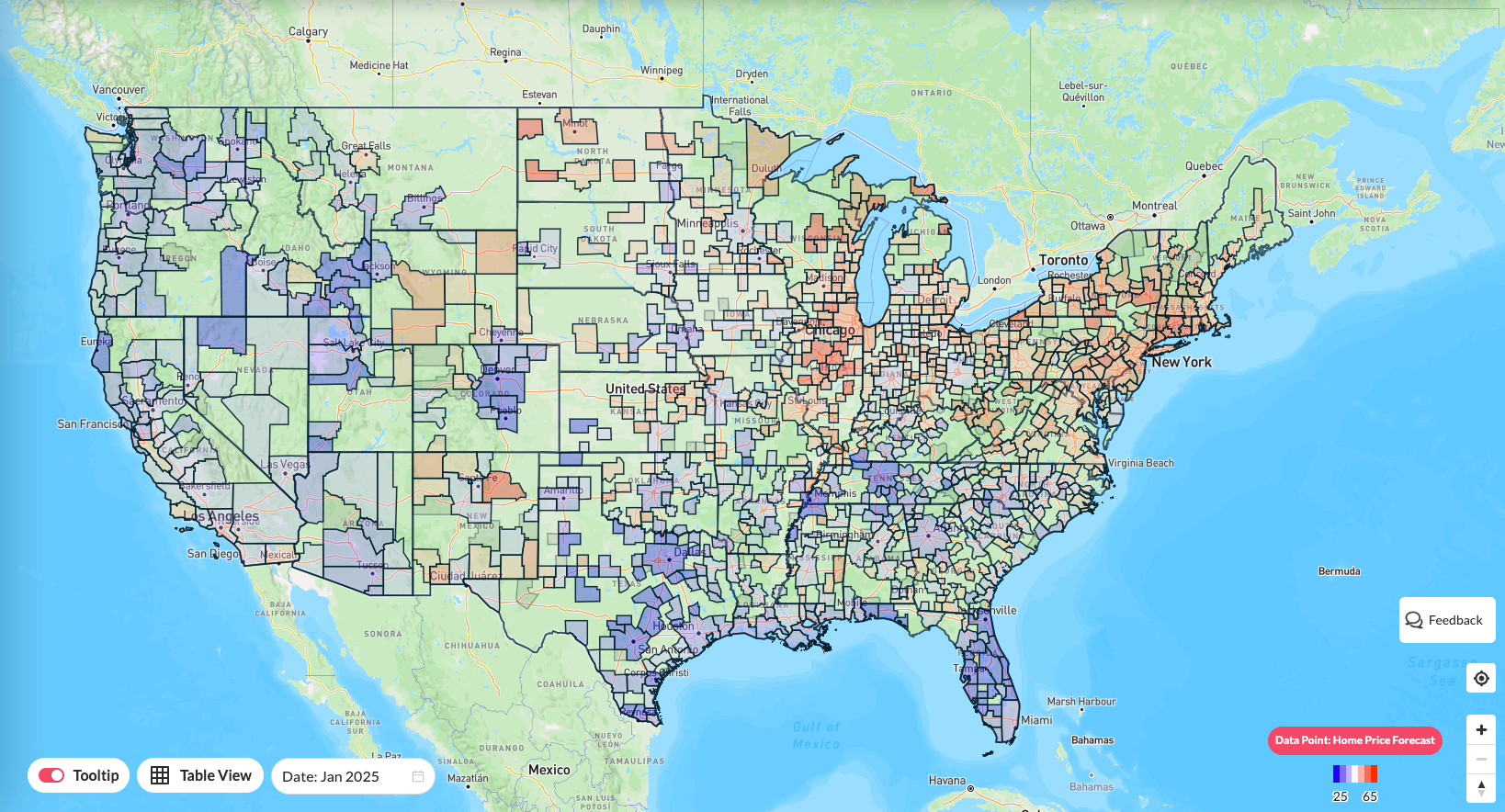
Recent Zillow data highlights how widespread these corrections have become. Counties surrounding Austin, Denver, and parts of the Bay Area continue to rank among America’s largest annual price declines.
Rather than seeing synchronized appreciation across America’s technology centers, we’re seeing one clear winner surrounded by markets still adjusting to higher mortgage rates and elevated inventory.

Inventory Still Favors Buyers in Many Tech Cities
Inventory trends reinforce this story. While San Francisco listings are shrinking, many competing technology markets continue adding supply.
King County, Washington, which includes Seattle, provides one of the clearest examples. Active inventory has surged well above historical norms, giving buyers more negotiating power and limiting price appreciation.
Higher inventory typically reduces upward price pressure because buyers have more choices. That’s exactly why Seattle’s housing market continues to lag behind San Francisco despite its strong technology sector.

What the San Francisco Home Prices Surge Means for Buyers and Investors
The San Francisco Home Prices Surge demonstrates that housing markets increasingly respond to local supply and demand rather than broad national narratives.
AI may be transforming the economy, but today’s housing data shows that its benefits remain highly concentrated.
Investors expecting every technology market to rebound together are likely to be disappointed. Instead, each metro should be evaluated based on inventory trends, affordability, migration patterns, and local employment growth.
Investors should also watch changing short-term rental economics, which are reshaping demand in many markets. Our analysis explains how the Airbnb slowdown is affecting local housing markets.
This divergence also creates opportunities. Buyers searching in markets like Austin, Seattle, Denver, or the East Bay may continue finding greater negotiating leverage than buyers competing in Downtown San Francisco.
The Bigger Story Is Just Beginning
The San Francisco Home Prices Surge may be the first visible sign of how artificial intelligence is reshaping America’s housing market. Rather than lifting every technology hub equally, AI appears to be concentrating housing demand in a handful of locations where investment, hiring, and office activity are strongest.
That makes local housing data more important than ever. Markets can now move in completely different directions despite sharing similar industries and economic fundamentals.
That growing divergence is also changing how forecasters view the market. See why Zillow’s updated 2026 housing market forecast now reflects a very different outlook across U.S. cities.
To stay ahead of these changes, use the Reventure App to track inventory, home values, demand, affordability, and local housing forecasts at your ZIP code level.
Understanding those local trends today can help you identify tomorrow’s winners before the rest of the market catches on.

Frequently Asked Questions
1. Will home prices in California go down in 2026?
It depends on the market. Some areas, like the East Bay, are still seeing price declines, while San Francisco home prices are rising as AI-driven demand strengthens.
2. Will property prices increase in 2026?
Some markets are expected to post modest gains, while others may continue correcting due to higher inventory and affordability challenges. Local supply and demand will determine the outcome.
3. Why are so many people leaving San Francisco?
Remote work and high living costs encouraged many residents to leave after the pandemic. However, AI investment is now bringing workers and housing demand back to San Francisco.
4. Are house prices going down in San Francisco?
No. San Francisco home prices are currently rising as inventory tightens and buyer demand rebounds, especially in neighborhoods benefiting from the AI boom.
5. How can I track San Francisco home prices and inventory?
The Reventure App lets you track San Francisco home prices, inventory, affordability, and ZIP code-level housing trends to stay ahead of market changes.






3 Responses