Manhattan housing inventory just plunged 14% year-over-year, while the apartment vacancy rate has fallen to only 1.49%. Instead of New Yorkers flooding the market with homes and leaving the city, available housing is becoming even harder to find. That is almost the exact opposite of what many expected from the Mamdani exodus.
After Zohran Mamdani was elected mayor in late 2025, one of the dominant housing narratives was that higher-income homeowners, landlords and businesses could leave New York City. If that happened, more properties would presumably hit the market, inventory would rise, and housing costs could come under pressure.
So far, the data is telling a very different story.
Manhattan for-sale inventory has fallen to its lowest level since 2017. Rental listings are down 16% from last year. Median rents have reached a record $5,295 per month. Meanwhile, homebuyer demand is holding relatively steady.
Rather than an exodus creating more housing supply, New York could now face the opposite problem: too few homes for the people who still want to live there.
And if this supply contraction continues, both home prices and rents could rise further through 2026 and into 2027.
Mamdani Exodus Expectations Meet a 14% Inventory Drop
The sharp decline in Manhattan housing inventory is particularly surprising because many expected the opposite after the 2025 mayoral election.
The argument was straightforward.
If homeowners became concerned about New York City’s political or economic direction, some might sell and relocate. An increase in listings would then give buyers more choices and potentially put downward pressure on prices.
But Manhattan’s housing market hasn’t followed that script.
That is a major reversal from the uncertainty surrounding the market before the election, when we examined whether a Mamdani victory could trigger a mass NYC housing exodus.
For-sale inventory has instead fallen 14% year-over-year, reaching its lowest level since 2017.
The chart below shows how abrupt that reversal has been. After Manhattan inventory increased to 6,731 listings in 2025, supply dropped to just 5,787 in July 2026. Instead of a post-election flood of properties hitting the market, available homes are disappearing.

That changes the housing equation considerably.
Home prices are ultimately determined by the balance between supply and demand. Even relatively modest demand can support higher prices when the number of homes available for purchase falls sharply.
Reventure currently forecasts approximately 1.7% home price growth in Manhattan through mid-2027.
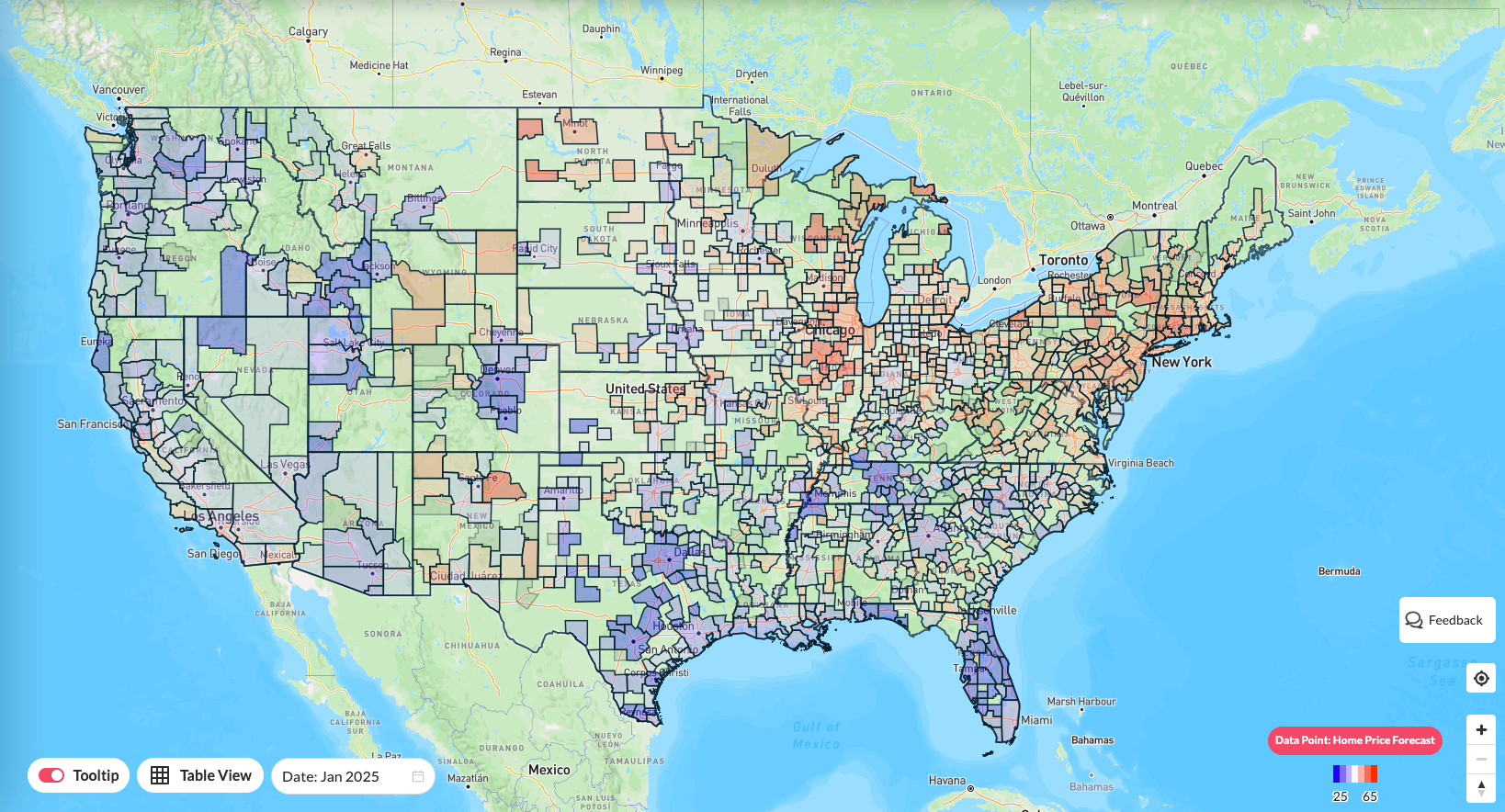
The forecast map puts that outlook into perspective. Reventure currently expects Manhattan home values to rise from approximately $1.22 million to $1.24 million over the next year, even before accounting for what could happen if the latest inventory contraction continues.

However, if inventory continues declining at its current pace, that forecast could eventually be revised higher.
The Mamdani Exodus Is Missing From the Rental Market Too
The shortage isn’t limited to homes for sale.
Manhattan’s rental market is arguably even tighter.
Median rent recently reached a record $5,295 per month, while rental listings have declined approximately 16% year-over-year.
Available apartments are also disappearing faster.
Days on market for rentals have dropped roughly 29% from last year, indicating renters are competing for a shrinking number of available units.
Meanwhile, the apartment vacancy rate is only 1.49%.
The rental data makes the supply problem especially clear. Manhattan isn’t simply dealing with fewer homes for buyers; renters are confronting record prices and declining availability at the same time.
Taken together, these figures point to an extremely constrained rental market.
This creates an unusual political challenge.
The absence of a major Mamdani exodus may undermine predictions that residents would flee New York. But declining housing supply could create another problem for the new administration: increasingly expensive housing.

If rental inventory continues falling while demand remains stable, rents could climb even further.
Manhattan Housing Demand Is Holding Up
Supply only tells half the story.
For prices to rise sustainably, buyers still need to exist.
And despite historically expensive housing and elevated mortgage rates, Manhattan demand has remained relatively resilient.
Approximately 900 home sales occurred in June 2026.
That’s somewhat below historical norms, but broadly within the range Manhattan has experienced over the last four years.
The sales data reinforces an important distinction: Manhattan isn’t experiencing a housing demand boom. But buyers haven’t disappeared either. Roughly 900 transactions still occurred in June, leaving enough demand to compete over a rapidly shrinking pool of listings.

This creates a significant imbalance.
Demand isn’t booming, but it isn’t collapsing either.
Supply, meanwhile, is contracting quickly.
When the number of buyers stays relatively stable while the number of available properties falls, sellers gain negotiating power. That can support prices even without a traditional housing demand boom.
And New York might also be benefiting from a larger post-pandemic migration shift.
Are Americans Moving Back to Major Cities?
During the pandemic, migration flowed heavily toward suburbs and lower-cost Sun Belt markets.
Remote work allowed millions of Americans to reconsider where they lived, helping drive enormous housing booms in Florida, Texas, Arizona and other lower-cost states.
But that trend may now be changing.
New York isn’t alone. San Francisco is experiencing its own housing market resurgence, with AI investment, tightening inventory and renewed demand pushing home prices higher.
San Francisco is experiencing some of the same dynamics as New York, potentially to an even greater degree. Housing demand has strengthened in portions of the Bay Area as technology companies—particularly those connected to artificial intelligence—expand hiring and investment.
New York could be experiencing a similar return to major economic hubs.
As employers increase office attendance and industries such as AI continue concentrating highly paid jobs in major cities, the economic value of living near New York’s employment centers could increase again.
If that continues, predictions of a Mamdani exodus could run directly into another powerful trend: Americans returning to major cities.
The Housing Boom Extends Beyond NYC
New York City’s strength also isn’t happening in isolation.
Housing markets throughout New York State are recording significant home price appreciation.
Westchester and Nassau counties remain highly competitive, while markets such as Albany, Buffalo and Syracuse have experienced substantial price growth.
Upstate New York has actually emerged as one of the strongest housing regions in America.
Syracuse home values have increased roughly 49% over five years, while Rochester has also ranked among the country’s fastest-appreciating metros.
That suggests something larger may be occurring.
Buyers priced out of New York City and its immediate suburbs have more affordable options farther north. At the same time, limited inventory across much of the state continues supporting home values.
The result is unusual: both expensive downstate markets and comparatively affordable Upstate cities are experiencing housing supply constraints.
Lower Manhattan Could See Some of the Strongest Growth
Even within New York City, however, the outlook varies considerably by neighborhood.
Reventure’s latest housing forecasts currently show some of the strongest potential appreciation in Lower Manhattan and the Upper East Side.
Zooming into the ZIP-code level reveals just how different the outlook can be within a few miles. Parts of Lower Manhattan currently carry forecasts above 3%, while other Manhattan ZIP codes are projected to remain flat or decline.

That’s why citywide averages only tell part of the story.
Some NYC neighborhoods could experience stronger price growth because inventory is especially constrained, while others could remain relatively flat.
If Manhattan inventory continues declining, Reventure expects to reassess these forecasts in the coming months.
And another economic indicator could add further support.
Manhattan Office Leasing Is Recovering
New York’s commercial real estate recovery could have important implications for residential housing.
Manhattan office leasing has recently surged, with activity reportedly reaching levels not seen in roughly two decades.
And this isn’t just a residential housing story. Manhattan’s commercial recovery is providing another signal that economic activity is returning to the city rather than fleeing it.

A stronger office market matters because it can reinforce the connection between employment and housing.
More workers returning to offices increases the appeal of living near Manhattan employment centers. Companies expanding their footprints can also support local employment, restaurants, retail, and other businesses that depend on office workers.
That could further strengthen housing demand at the same time residential supply is shrinking.
What Happens to NYC Housing Prices Next?
The current NYC housing market is developing very differently from what many expected following the 2025 election.
The anticipated surge in homes hitting the market hasn’t materialized.
Instead, Manhattan for-sale inventory is down 14%, rental listings are down 16%, vacancy has fallen to 1.49%, and median rent has reached a record $5,295 per month.
Meanwhile, housing demand remains relatively stable.
That combination could keep upward pressure on both home values and rents through the remainder of 2026 and into 2027.
Of course, real estate in New York is extremely local. Conditions in Lower Manhattan can look very different from those in Brooklyn, Queens, or individual neighborhoods only a few miles away.
That’s why buyers shouldn’t treat a 1.7% Manhattan forecast as applicable to every neighborhood. The more useful question is what inventory, valuation and forecast data look like for the specific ZIP code where you’re considering buying.

Before buying, use Reventure’s 1-Year Price Forecast to see where home values are projected to move in your ZIP code and compare local inventory, overvaluation and other market indicators.
Premium plans start at $39 per month.
For now, the biggest surprise in New York isn’t the Mamdani exodus many anticipated.
It’s how little housing is actually available.