

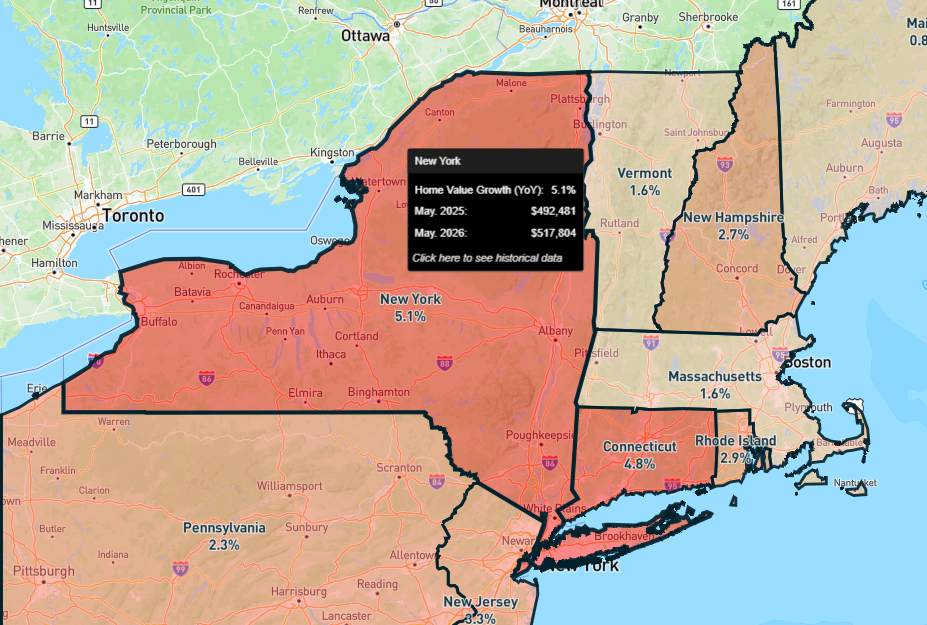
The New York housing market is having a moment right now.
Five of the top 10 home price appreciation markets in the United States are now located in New York State. Even more surprising, every one of them is in Upstate or Western New York. That’s a remarkable turnaround for a region that many investors largely ignored while pouring money into Florida, Texas, and other Sun Belt markets.
According to the latest housing market data available on the Reventure App, Syracuse ranks as the nation’s fastest-appreciating housing market, followed by Albany at No. 2. Buffalo, Rochester, and Poughkeepsie also cracked the national top 10, highlighting a broader shift in where home prices are rising the fastest.
Meanwhile, several former boom markets in the Sun Belt are losing momentum as inventory climbs and buyer demand cools.
The reversal suggests the U.S. housing market has entered a new phase. Markets that struggled to attract attention over the past decade are now outperforming many of the country’s hottest pandemic-era destinations.
The question is, what’s driving this unexpected surge, and can the New York housing market continue to beat the rest of the country?

The New York Housing Market Has Entered a New Cycle
Housing markets move in cycles, and today’s leaders are not always tomorrow’s winners. During the pandemic, record-low mortgage rates and remote work fueled migration into Florida, Texas, and other Sun Belt states. Builders responded by rapidly increasing construction to meet soaring demand.
Now, those markets are adjusting to a different reality. Housing inventory has climbed while buyer demand has slowed under higher mortgage rates. More homes are competing for fewer buyers, creating downward pressure on prices in several once-hot markets.
The New York housing market is moving in the opposite direction. Demand has strengthened across much of Upstate New York, but new home construction has remained limited. That imbalance between buyers and available homes is supporting stronger price appreciation.
Five New York Cities Are Leading the Nation
The latest housing data highlights how dramatically the market has shifted. Syracuse now ranks as the fastest-appreciating housing market in America, while Albany, Buffalo, Rochester, and Poughkeepsie all sit inside the national top 10. Just a few years ago, few investors would have expected these cities to outperform markets like Tampa, Austin, or Phoenix.
The contrast becomes even clearer when you compare the nation’s top appreciation markets with the biggest decliners. The left side of the chart is dominated by cities that many Americans spent the last two decades leaving. Meanwhile, the right side is filled with Sun Belt metros that attracted millions of new residents during the pandemic housing boom.

The turnaround reflects changing market fundamentals rather than short-term hype. These metros never experienced the building boom that flooded many Sun Belt markets with inventory. As demand has returned, limited supply has allowed prices to rise much faster than in many competing regions.
Why Upstate New York Is Outperforming
The strength of the New York housing market isn’t the result of a single trend. Instead, several structural factors are working together to push home prices higher across Upstate and Western New York.
Tight Inventory Is Driving Home Prices Higher
The biggest factor behind Upstate New York’s surge is limited housing supply. Builders added relatively few new homes over the past decade, leaving many communities with historically low inventory. As more buyers entered the market, competition increased, pushing home prices higher across the region.
Unlike markets with abundant new construction, Upstate New York has avoided a supply glut. That shortage continues to support price growth, even as other parts of the country experience slower sales and rising inventory.
Why Reverse Migration Is Fueling the New York Housing Market
Migration patterns are also beginning to shift. More former residents are returning to New York to be closer to family, employment opportunities, and established communities. Hybrid work has made that decision easier by giving many professionals greater flexibility over where they live.
Combined with relatively affordable home prices, this steady return of buyers is creating stronger demand in markets that were overlooked for years. As long as inventory remains tight, these structural trends are likely to keep supporting the New York Housing Market.
Buffalo, Rochester, and Poughkeepsie Continue to Gain Momentum
The strength of the New York housing market extends well beyond Syracuse and Albany. Buffalo and Rochester are benefiting from many of the same forces, including limited inventory, stable employment, and renewed buyer demand. Once viewed as slow-growth Rust Belt cities, both markets are now attracting buyers looking for affordability and long-term value.
Poughkeepsie is also seeing strong appreciation, driven largely by its proximity to New York City. Hybrid work has enabled more professionals to move farther from Manhattan without sacrificing access to high-paying jobs. That flexibility has increased demand across the Hudson Valley while keeping inventory tight.
Together, these markets demonstrate that New York’s housing recovery is broad-based. Appreciation is no longer limited to one or two cities but is spreading across multiple regions with strong housing fundamentals.
This Isn’t a New York City Exodus Story
Some observers have suggested that Upstate New York’s housing boom is the result of people fleeing New York City. While that explanation makes for an appealing headline, the data tells a different story. The appreciation trend across Upstate New York began well before recent political debates and has continued alongside improving conditions in New York City itself.
Even more importantly, New York City’s housing market is strengthening. Home values are rising across all five boroughs, with annual appreciation ranging from roughly 2% in Manhattan to nearly 6% in the Bronx. If buyers were leaving New York City in large numbers, those gains would be difficult to sustain.
Some commentators have attributed Upstate New York’s housing boom to an exodus from New York City. The housing data suggests otherwise. In the video below, I explain why reverse migration, tight inventory, and changing buyer preferences are driving New York’s housing market and not a sudden political flight from the city.
Recent housing data shows that home values across New York City’s five boroughs are also rising year over year. That means demand remains healthy across the state rather than simply shifting from one region to another. Instead of an exodus, New York appears to be benefiting from a broader improvement in housing demand.
Why Florida and Texas Are Losing Momentum
While New York struggles with too few homes for sale, many Sun Belt markets face the opposite challenge. Builders dramatically increased construction during the pandemic housing boom, creating a wave of new inventory that is now reaching the market. At the same time, migration into many of these cities has slowed as affordability has worsened.
The result is a cooling market. Buyers now have more choices, sellers are cutting prices, and homes are taking longer to sell. That doesn’t mean every market in Florida or Texas will decline, but it does explain why many of the country’s strongest appreciation markets have shifted back toward the Northeast.
What It Means for Buyers and Investors
The biggest lesson from today’s New York housing market is that housing cycles constantly evolve. Investors who continue chasing yesterday’s hottest markets risk missing opportunities in regions with stronger long-term fundamentals. Markets with limited inventory, stable employment, and improving migration trends often outperform once the cycle changes.
For buyers, local data matters more than national headlines. Inventory levels, job growth, and neighborhood demand can vary significantly from one city to another. Understanding those trends can help buyers make better decisions as the housing market continues to shift.
Why the New York Housing Market Could Continue to Outperform
The New York housing market has quietly become one of America’s strongest housing stories. Upstate cities are leading the nation in home price appreciation, while many former pandemic boomtowns adjust to rising inventory and slowing demand. If current trends continue, New York’s combination of tight supply, improving migration, and relative affordability could support further gains over the next several years.
These trends also extend beyond New York. States like Connecticut, Illinois, and parts of the Midwest are beginning to benefit from many of the same structural forces, including constrained inventory, improving migration patterns, and more balanced housing markets.
For buyers and investors, the biggest opportunities may no longer be in yesterday’s hottest markets, but in regions where supply remains tight and demand is steadily improving.
To stay ahead of these trends, it’s important to monitor your local housing market and not just the national headlines. Every city, county, and ZIP code behaves differently, and understanding those differences can give buyers and sellers a meaningful edge.

Track Your Local Housing Market
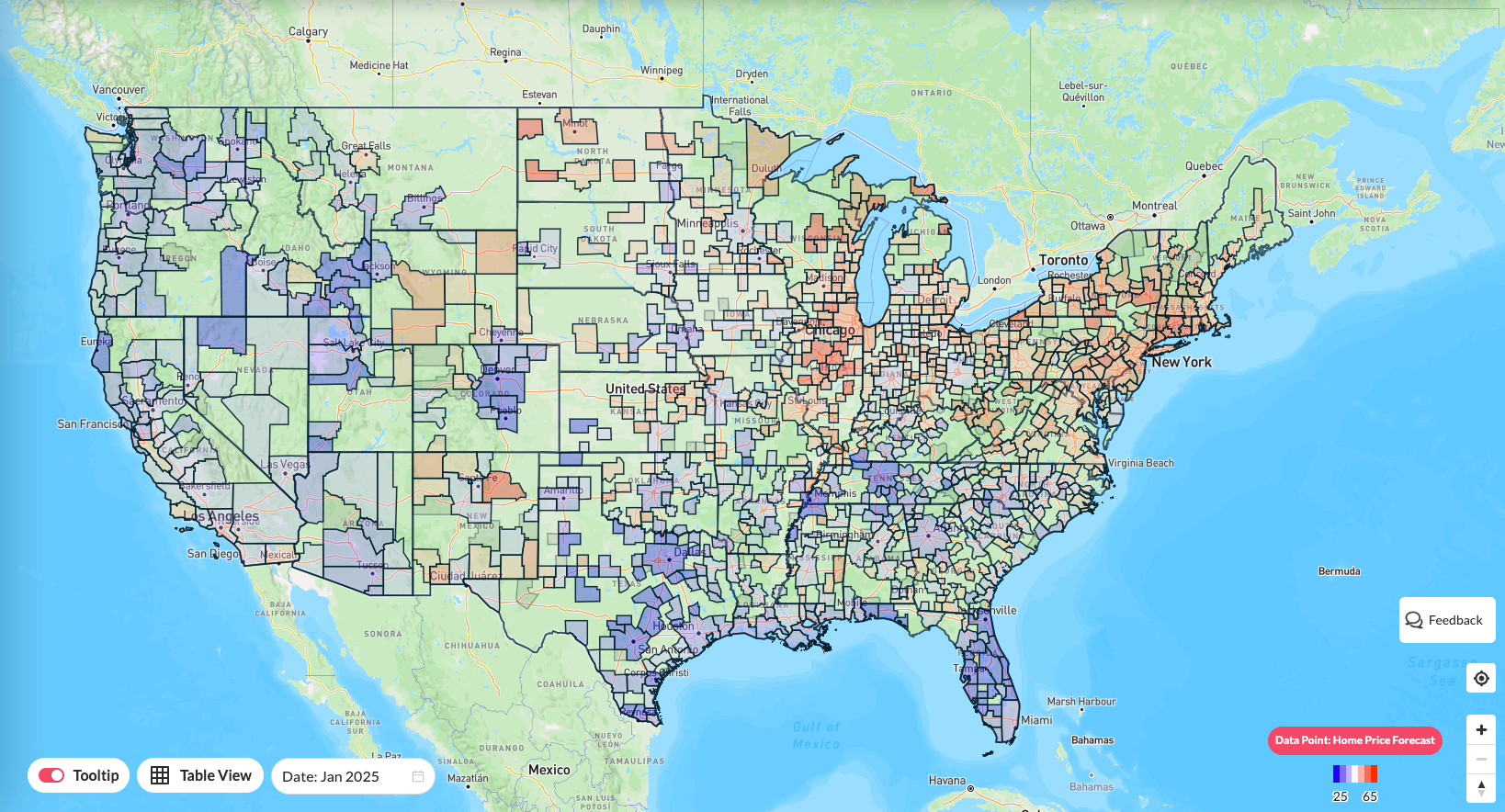
Whether you’re buying, selling, or investing, local data matters. The Reventure App lets you track home prices, inventory, appreciation trends, and market forecasts for your city or ZIP code, helping you make smarter real estate decisions based on data and not headlines.






4 Responses