

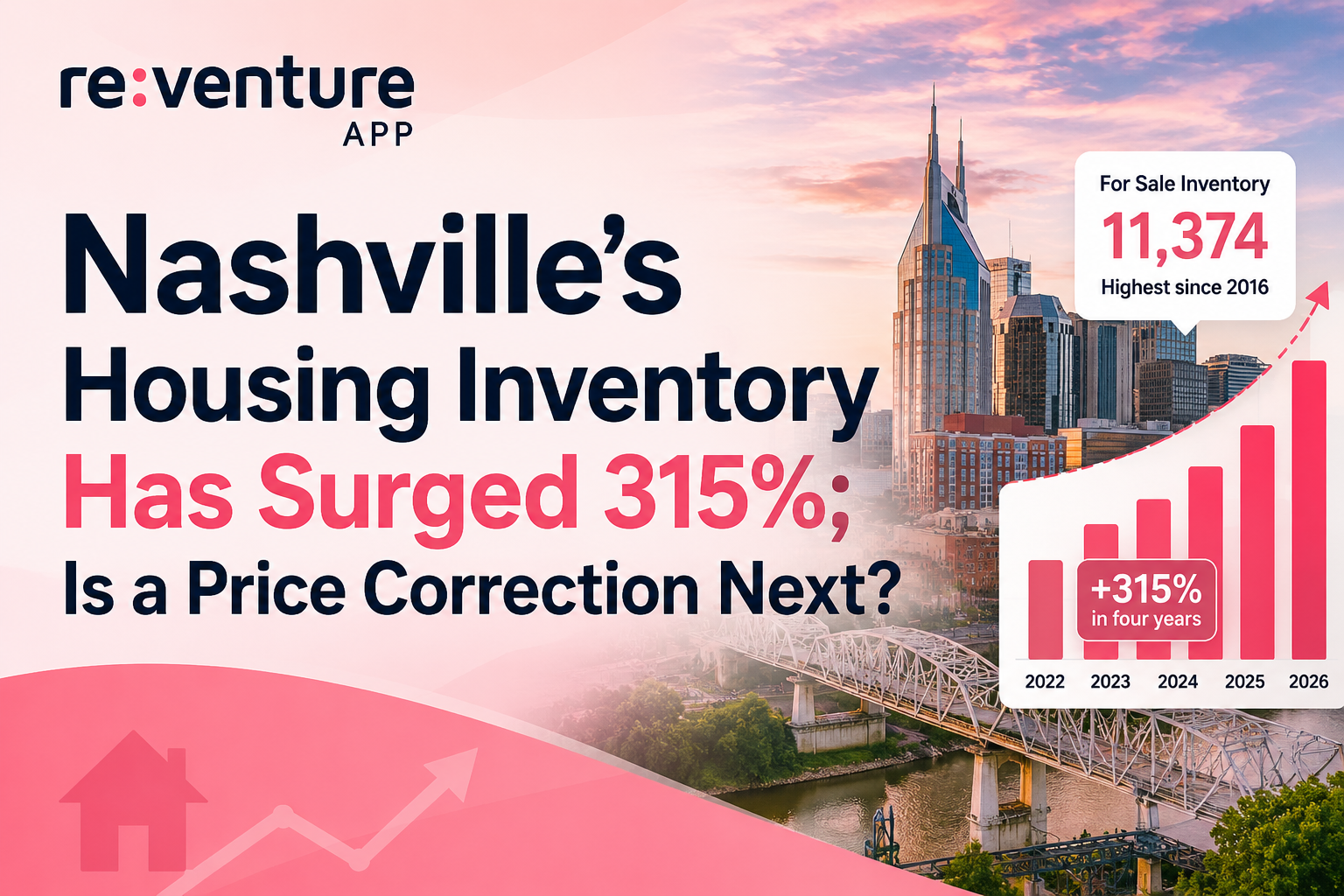
Something big is happening with Nashville Housing Inventory.
Housing supply has climbed to more than 11,000 active listings, marking a staggering 315% increase over the past four years. That’s the highest level of inventory the metro has seen in at least a decade, and it comes at a time when buyer demand is beginning to weaken.
The latest data from the Reventure App paints a very different picture from the pandemic housing boom. Inventory continues to rise while home sales remain below their long-term average. Buyers have more choices than they’ve had in years, giving them greater negotiating power and shifting the market firmly in their favor.
Home prices have remained surprisingly resilient despite the surge in listings. But early signs of weakness are emerging, especially in Nashville proper, where home values have already declined year over year. The big question now is whether rising supply will eventually force broader price corrections across the metro.

Nashville Housing Inventory Is Growing Faster Than Almost Anywhere
The housing market has cooled across much of the country, but Nashville housing inventory continues moving in the opposite direction. Active listings reached 11,374 homes in May 2026, the highest May inventory level recorded in more than ten years. Even more striking, inventory now sits 68.5% above its long-term average, making Nashville one of the most oversupplied housing markets in America.
Unlike many metros where inventory growth has begun to stabilize, Nashville continues to add new listings faster than buyers can absorb them. That imbalance has steadily shifted negotiating power away from sellers and toward buyers. As more homes remain on the market, competition among sellers continues to increase.

The oversupply rankings highlight just how unusual Nashville’s market has become. Only Seattle, Memphis, and Denver currently have a larger inventory surplus relative to historical norms. For a market that was one of the nation’s hottest during the pandemic, the turnaround has been remarkably fast.
Why Nashville Housing Inventory Keeps Climbing
Several factors are driving the rapid increase in supply. During the pandemic, Nashville experienced one of the strongest housing booms in the country as buyers relocated from higher-cost markets. Builders responded by ramping up construction, while homeowners rushed to capitalize on record-high prices.
Today’s market looks very different. Higher mortgage rates have reduced affordability, causing many buyers to postpone purchases or remain in rentals. At the same time, new listings continue entering the market, creating more supply than current demand can absorb.
Demand has also failed to return to pre-pandemic levels. Home sales remain well below the pace seen between 2017 and 2021, leaving many listings without buyers. As inventory continues to build, homes are spending more time on the market, increasing pressure on sellers to become more competitive.
Buyer Demand Is Losing Momentum
The slowdown in demand is becoming increasingly visible across the metro. While annual sales have improved slightly compared to last year, activity remains roughly 10% below historical norms. Before the pandemic, Nashville regularly recorded between 3,500 and 4,000 home sales each May. This year, sales totaled only about 3,200, despite a much larger supply of homes available for purchase.

The gap between rising inventory and weaker demand is creating one of the strongest buyer’s markets Nashville has seen since the last housing downturn. For prospective buyers, that shift could create better negotiating opportunities in the months ahead.
Rising Inventory Is Starting to Pressure Prices
So far, home prices across metro Nashville have held up better than many analysts expected. However, that resilience is beginning to fade in some parts of the market. As inventory continues climbing and buyers become more selective, sellers are finding it harder to command the prices they could just a few years ago.
The biggest signs of weakness are already appearing in Davidson County, which includes downtown Nashville. According to Zillow’s Home Value Index, home values in the county are now down 3.3% year over year. Rutherford County has also slipped into negative territory, suggesting the price correction is no longer just a risk—it’s already underway in parts of the metro.

Not every part of the metro is weakening at the same pace. Williamson County continues to post modest annual appreciation thanks to higher household incomes and stronger demand for luxury housing. That divergence shows why buyers and investors should evaluate housing conditions at the county and ZIP-code level rather than relying solely on metro-wide averages.
If you’re wondering which parts of the Nashville metro still offer the strongest long-term buying opportunities, watch the video below. I break down the neighborhoods and counties with the best housing fundamentals and explain why local market conditions matter more than ever in today’s buyer’s market.
Homes Are Taking Longer to Sell
One of the clearest signs of a shifting market is the increase in days on market. During the pandemic boom, many homes sold within days of being listed as buyers competed aggressively for limited inventory. Today’s market looks very different.
Across metro Nashville, the median home now spends 52 days on the market, compared with a historical May average of about 32 days. That 20-day increase reflects a market where buyers have more time to compare properties, negotiate prices, and walk away if a home feels overpriced.
Longer selling times also increase pressure on homeowners. Sellers who initially refuse to lower their asking price often become more flexible after several weeks without serious offers. That dynamic tends to create better opportunities for patient buyers, especially later in the year when seasonal demand slows.
Buyers Have More Leverage Than They’ve Had in Years
Conditions on the ground reinforce what the data already shows. Many buyers no longer feel pressured to submit offers immediately because there are far more homes to choose from. Renting also remains relatively affordable in Nashville, with many apartment communities still offering incentives such as free rent or renewal discounts.
Sellers, meanwhile, are slowly adjusting to the new reality. Many still price their homes based on peak-pandemic expectations, only to discover that today’s buyers are far less willing to stretch their budgets. As listings sit on the market longer, price reductions and negotiations are becoming increasingly common.
For buyers, this could create one of the best negotiating environments Nashville has seen in years. Sellers who remain unsold through the summer may become even more motivated as the fall and winter markets approach. That could create opportunities to secure better pricing or negotiate concessions that were nearly impossible during the housing boom.
What Nashville Housing Inventory Means Going Forward
The rapid rise in Nashville housing inventory marks a significant shift in one of America’s hottest housing markets. Supply has surged while buyer demand remains below historical norms, creating conditions that increasingly favor buyers over sellers. If inventory continues climbing, broader price corrections could become more likely across additional parts of the metro.
That’s why local market data matters more than ever. Housing conditions can vary dramatically between Davidson, Williamson, and Rutherford counties, and even between neighboring ZIP codes. Understanding where inventory is rising fastest can help buyers identify opportunities before the broader market catches up.

The Reventure App lets you track Nashville’s Housing Inventory, home prices, buyer demand, and local market conditions down to the ZIP-code level. Whether you’re buying, selling, or investing, having access to local housing data can help you make smarter decisions in a rapidly changing market.
Explore your market now on the Reventure App.
Frequently Asked Questions
1. Are housing prices dropping in Nashville?
Yes, home prices are beginning to decline in parts of the Nashville metro. Davidson County is already down 3.3% year over year, while other areas remain more resilient. Rising inventory and slower buyer demand could put additional downward pressure on prices.
2. Is Nashville a good housing market to buy in 2026?
Nashville is becoming a stronger buyer’s market. Housing inventory is at its highest level in more than a decade, giving buyers more negotiating power and a wider selection of homes. Patient buyers may find better deals as sellers adjust to changing market conditions.
3. Why are people moving out of Nashville?
Higher housing costs, elevated mortgage rates, and slowing job growth have reduced demand compared to the pandemic boom. While Nashville continues to attract new residents, fewer buyers are entering the market, contributing to rising inventory and longer selling times.
4. What is the richest community in the Nashville metro?
Williamson County is widely considered the wealthiest area in the Nashville metro. It has some of the highest median home values and household incomes in Tennessee and continues to outperform many neighboring counties despite the broader market slowdown.
5. What is the average time to sell a home in Nashville?
Homes in the Nashville metro spent a median of 52 days on the market in May 2026, compared with a long-term May average of about 32 days. Longer selling times reflect weaker buyer demand and increasing leverage for homebuyers.







3 Responses