Florida Property Tax Cuts Could Reshape the Housing Market in 2027. Home Values Already Down 7%

 August 26, 2026

Florida homeowners could soon receive one of the biggest property tax breaks in the state’s history. And it would arrive at a moment when the housing market desperately needs some relief.
Home values across Florida are already down roughly 7% statewide since mid-2024. Home sales remain 11% below their long-term average and about 30% below the pandemic peak, while Florida now ranks first nationally for foreclosure activity.
Yet voters could soon change one important part of the affordability equation.
On November 3, 2026, Floridians are set to vote on Amendment 3, a proposed property tax relief measure that would substantially increase the Homestead Exemption for non-school property taxes. For some homeowners, the eventual savings could approach $2,000 per year.
That raises an intriguing question: could Florida Property Tax relief finally bring buyers back into the market?
The answer is probably yes—at least to some degree. But the data suggests tax relief alone may not be powerful enough to end Florida’s broader housing correction.
Florida Property Tax Costs Are Among the Highest in America
Florida is usually associated with expensive homeowners insurance. But property taxes have quietly become an equally important affordability problem.
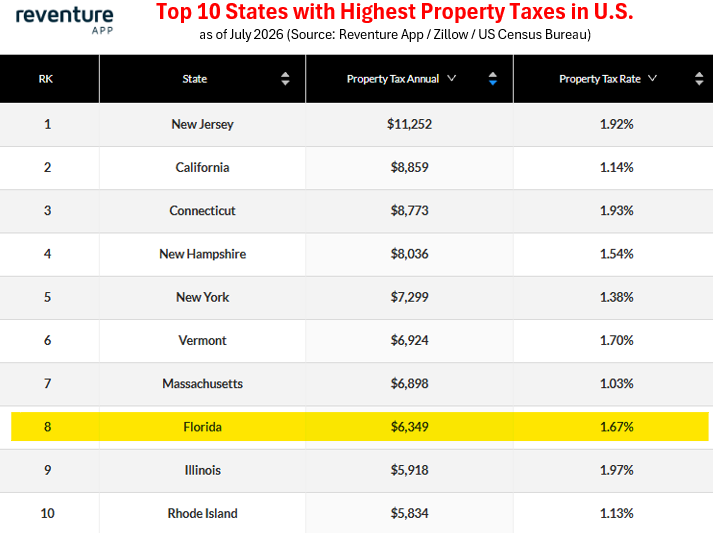
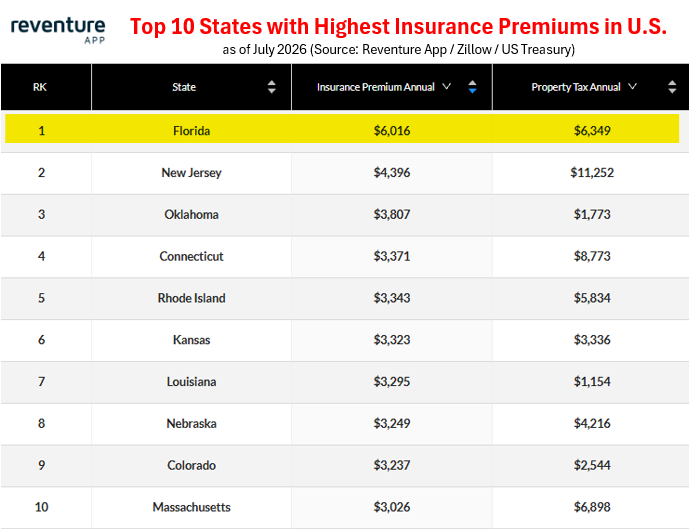
According to Reventure data, the typical Florida home carries approximately $6,349 per year in property taxes, ranking the state eighth nationally in nominal property tax costs.
The typical effective tax rate is approximately 1.67%, among the highest in the country. The national comparison puts that burden into perspective. Florida may be known as a low-tax state because it has no individual state income tax, but homeowners face a very different reality when it comes to the recurring cost of owning property.
Then add insurance.
Florida homeowners pay roughly $6,016 annually in homeowners insurance premiums, according to Reventure data. Combined, the typical homeowner can face more than $12,000 per year in taxes and insurance.
But property taxes are only half of Florida’s ownership-cost problem. When insurance is included, Florida moves into an even more extreme position nationally—and explains why falling home prices haven’t necessarily translated into affordable monthly payments.
That is before paying principal, interest, HOA fees, or maintenance.
For existing homeowners who purchased years ago, Florida’s Save Our Homes protections can soften the blow. But for someone entering the market today, the calculation can look very different.
Why Florida Property Tax Costs Hit New Buyers Harder
Florida’s current tax structure provides a major advantage to long-term homeowners.
Under the Save Our Homes system, annual increases in the assessed value of a homesteaded property are generally capped at 3% or inflation, whichever is lower.
But when ownership changes, the property can be reassessed closer to market value.
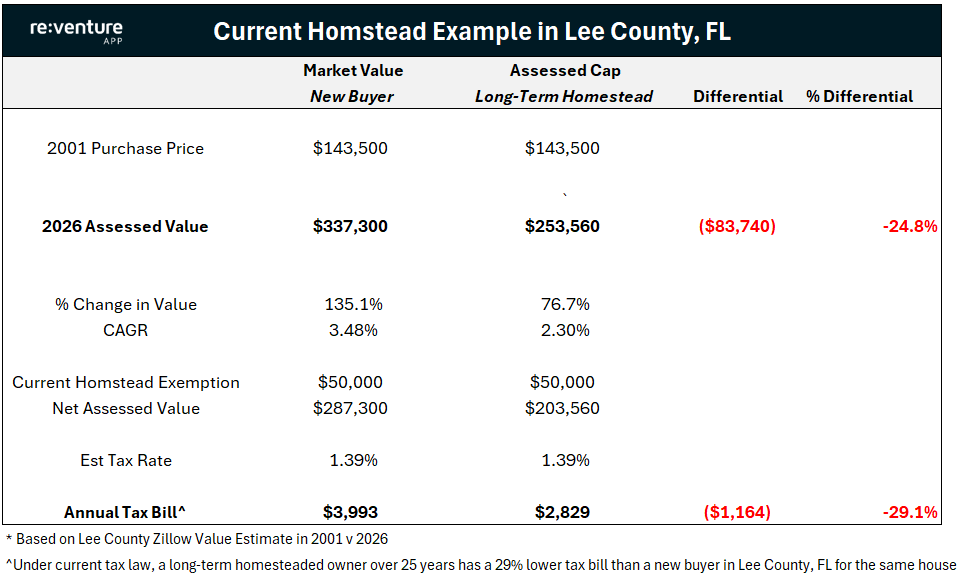
Consider a hypothetical Lee County home worth $337,300 in 2026.
Using a $50,000 Homestead Exemption and an estimated 1.39% tax rate, a new owner could face an annual property tax bill around $3,993.
A hypothetical owner who purchased the same property 25 years ago could have an assessed value closer to $253,560 because of the assessment cap. After the exemption, the resulting tax bill could be around $2,829.
That’s approximately $1,164 less per year, or 29% below what the new buyer might pay. The difference becomes much easier to see when the two homeowners are placed side by side. Even though they’re theoretically occupying the same Lee County house, Florida’s assessment rules can produce dramatically different tax bills depending on how long each person has owned the property.
This creates an unusual incentive.
Long-term homeowners have another financial reason to stay put, while prospective buyers inherit a substantially higher housing expense.
And Florida is already struggling to attract enough buyers.
Florida Homebuyer Demand Is 30% Below the Pandemic Peak
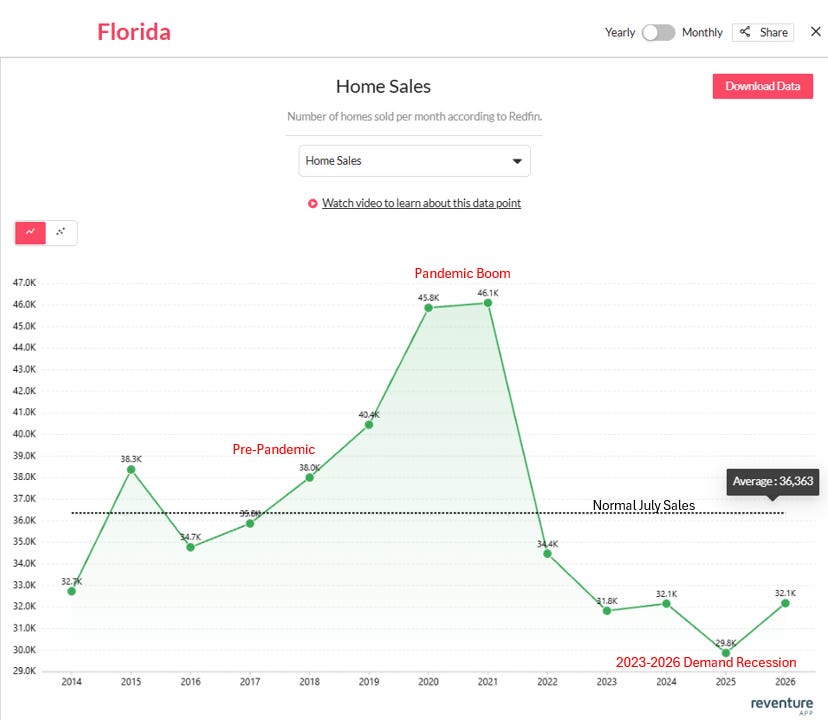
Only about 32,100 Florida homes sold in July 2026, according to Redfin data visualized by Reventure.
The average July since 2014 is approximately 36,363 transactions.
That puts current sales roughly 11% below the long-term norm.
Compared with the pandemic peak, sales are down approximately 30%. Even compared with 2018 and 2019, when July transactions typically approached 38,000 to 40,000, current demand remains unusually weak. The longer-term sales trend shows just how dramatic the reversal has been. Florida went from more than 45,000 July sales during the pandemic boom to only about 32,100 in July 2026, leaving transactions below both the pandemic peak and the longer-term July average.
Several forces are contributing.
Home prices remain elevated despite the recent correction. Mortgage rates are still expensive relative to pandemic levels. Migration has slowed, while insurance and property taxes have increased the true monthly cost of owning a home.
Reducing one of those expenses could therefore matter.
What Amendment 3 Could Change in 2027
If Amendment 3 receives the required voter approval in November, the proposal would significantly expand the Homestead Exemption for non-school property taxes.
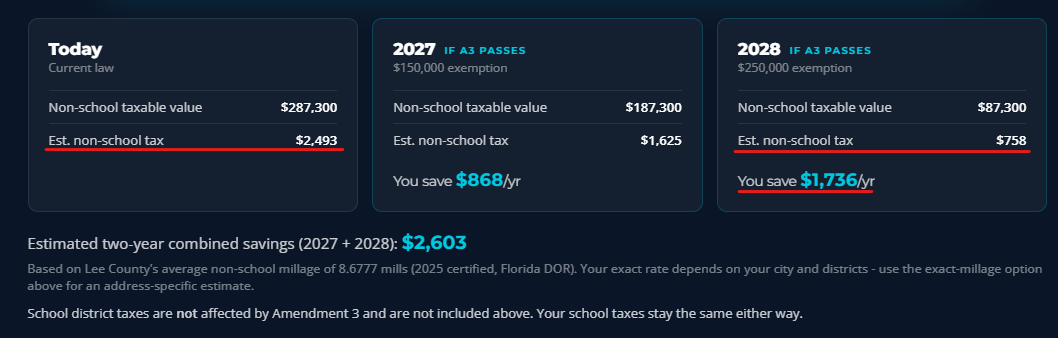
Under the proposal described in the thread, the exemption would increase from $50,000 today to $150,000 in 2027 and $250,000 in 2028. Beginning in 2029, the expanded exemption would be indexed to inflation.
The proposal would also change assessment rules affecting certain second homes, rental properties and commercial properties.
But the $250,000 exemption is the provision with the clearest implications for ordinary homeowners.
Consider the same $337,300 Lee County property.
With a $250,000 exemption applied to qualifying non-school taxes, the taxable value for that portion of the bill could fall dramatically.
Estimates for this hypothetical property suggest annual savings of approximately $1,736 by 2028. Here’s where the potential impact of Amendment 3 becomes much more tangible. For the hypothetical Lee County property, the expanded exemption would progressively reduce the non-school taxable value, producing meaningful savings in both 2027 and 2028.
That’s meaningful money for a household already dealing with expensive insurance, mortgage payments, and other ownership costs.
Florida Property Tax Relief Could Benefit Cheaper Homes Most
The percentage benefit wouldn’t be equal across Florida.
A $250,000 exemption represents a huge portion of the value of a $337,000 home. It represents a much smaller share of a $1 million property.
That means lower- and middle-priced housing markets could experience the largest relative reduction in tax burdens.
There is another important limitation.
The proposed structure favors established Florida residents, with newer residents facing restrictions before becoming eligible for the full enhanced exemption.
That makes a sudden new wave of interstate migration less likely.
Instead, the immediate housing effect could come from existing Florida renters and residents who were already considering purchasing.
Could Property Tax Relief Revive Florida Housing Demand?
The most likely short-term effect is a modest increase in transactions rather than another housing boom.
A major property tax reduction would improve the monthly affordability calculation for some prospective buyers. It could also create positive sentiment around Florida housing after several years of negative headlines.
Reventure estimates that sales could potentially increase around 5% to 10% year-over-year in 2027 following passage, although this is a directional estimate rather than a precise forecast.
Even a 10% rebound would only bring transactions closer to historical norms.
It wouldn’t recreate 2021.
That’s important because Florida’s correction involves much more than taxes.
Inventory remains elevated in numerous markets. Prices are still high relative to local fundamentals in some areas, insurance remains expensive, and slowing migration has removed one of the biggest sources of incremental housing demand.
Tax relief could help buyers.
It probably cannot solve all those problems.
Could Amendment 3 Reduce Florida Foreclosures?
The proposal could also affect existing homeowners.
Florida currently has some of the highest foreclosure activity in the country. Lower property tax bills would leave qualifying households with additional disposable income that could instead go toward mortgage payments, insurance and other expenses.
For financially stretched lower- and middle-income owners, saving $1,000 to $2,000 annually isn’t insignificant.
That could reduce some marginal mortgage distress.
But it wouldn’t eliminate foreclosure risk.
If Florida’s labor market deteriorates or unemployment rises, homeowners can still become delinquent regardless of property tax relief.
The proposal would therefore likely reduce financial pressure at the margin rather than reverse the foreclosure cycle altogether.
The Biggest Unknown Could Be Local Government
There is another variable buyers shouldn’t overlook: how counties and municipalities respond.
The Homestead Exemption affects the taxable value used for certain non-school local government taxes.
A substantially larger exemption could therefore reduce revenue available for county and municipal services unless governments adjust spending or find revenue elsewhere.
One potential response would be higher millage rates.
If local governments raise those rates sufficiently, part of the homeowner savings generated by the larger exemption could eventually be offset.
The ultimate tax reduction will therefore depend not only on the constitutional amendment, but also on how local governments react after implementation.
Will Florida Property Tax Cuts Stop the Housing Downturn?
Amendment 3 could provide meaningful relief to Florida homeowners and improve affordability for some buyers.
For a household saving nearly $2,000 annually, the benefit is real. Lower ownership costs could encourage some renters to buy, support a modest recovery in sales and potentially reduce financial stress among existing homeowners.
But Florida’s housing downturn is bigger than its tax bill.
Home values are already down around 7% statewide, demand remains below historical levels, foreclosures are elevated, and insurance, mortgage rates, and excess inventory continue weighing on many markets.
That’s why the most realistic outcome isn’t another Florida housing boom.
It’s a modest improvement in demand while the broader correction continues.
Amendment 3 could make 2027 better for buyers and homeowners than it otherwise would have been. But whether that translates into stable home prices will still depend on inventory, migration, employment and affordability.
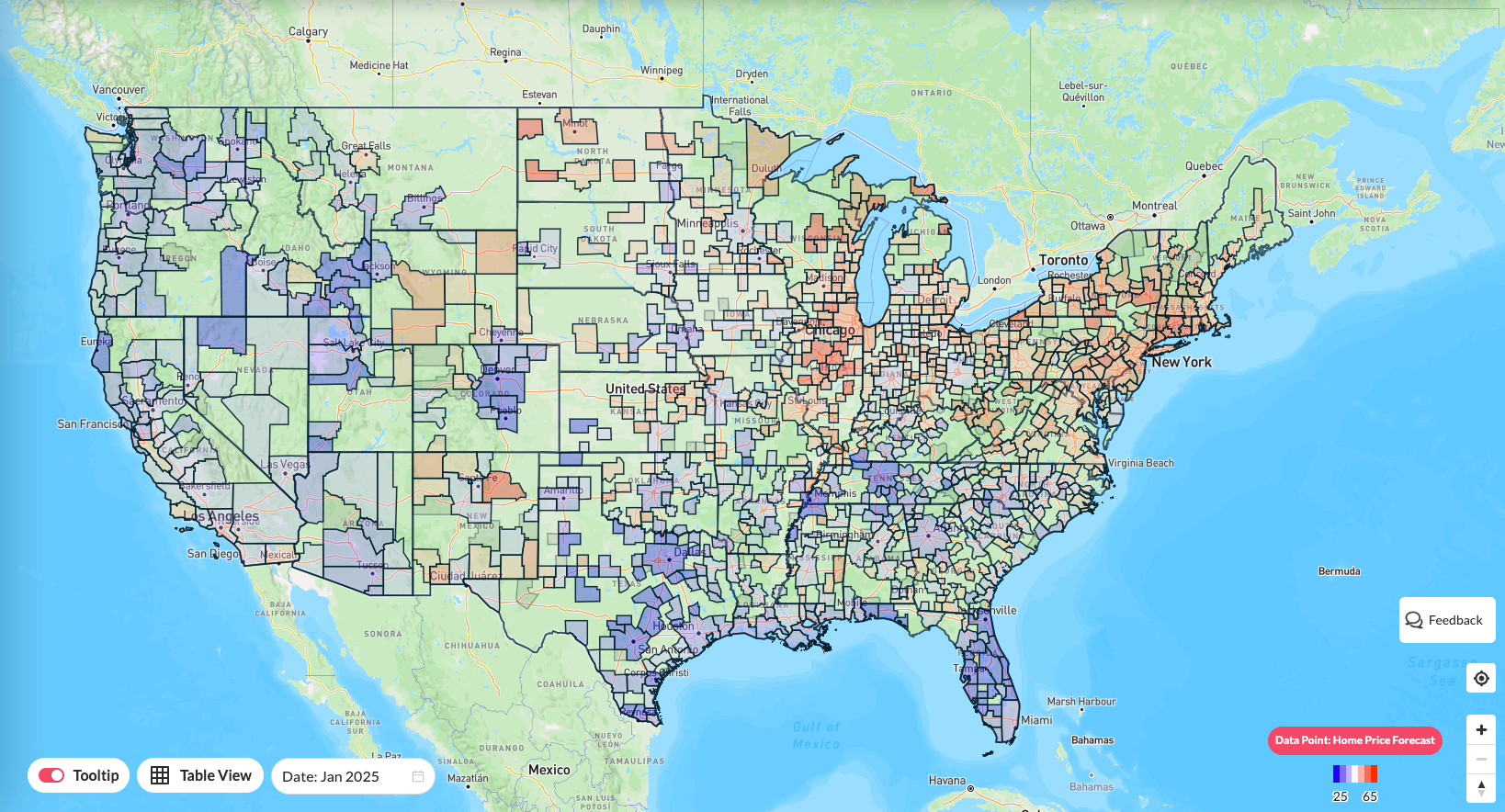
Buyers can track these trends through Reventure, including home values, inventory, sales activity and ZIP-code-level housing forecasts.
The proposed Florida Property Tax changes could remove one important obstacle for buyers.
The bigger question is whether removing that obstacle will be enough when so many other pressures are still pushing Florida housing in the opposite direction.