The Great Seller Stand-Off: Why Millions of Homes Are Being Delisted Instead of Dropped in Price

 November 3, 2025
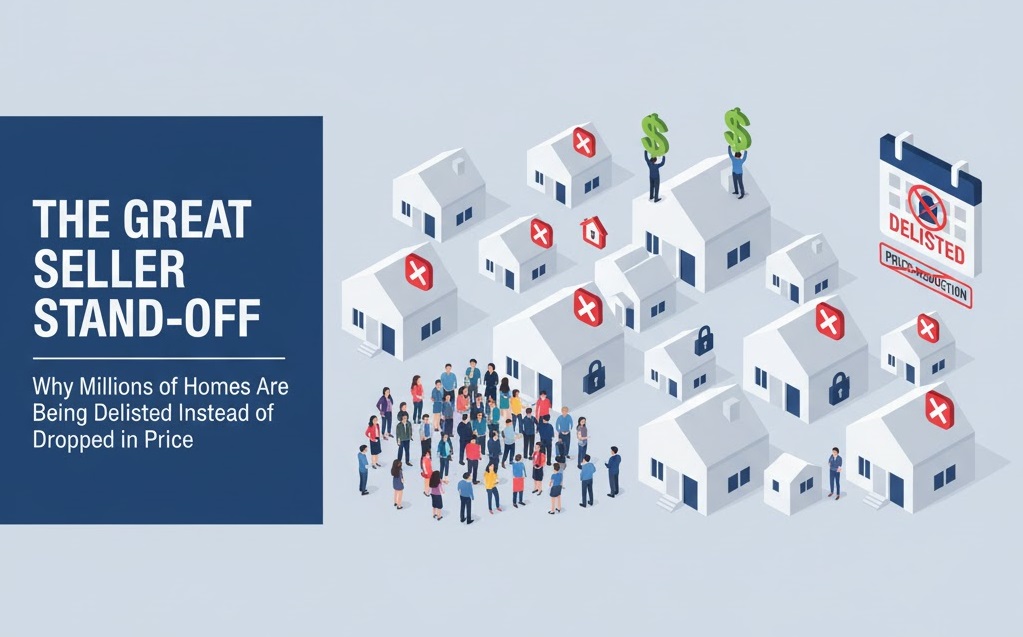
Ever wonder why home prices aren’t falling even when buyers are pulling back? You’re not alone. Across America, millions of homes are quietly vanishing from the market. They are not sold. They are simply delisted. Instead of trimming prices, sellers are stepping back. They are waiting for better days and keeping supply painfully tight.
It’s a tug-of-war between reality and hope. Higher mortgage rates have cooled demand, but homeowners locked into cheap pandemic loans aren’t budging. They’d rather sit on the sidelines than surrender their low rates or their price dreams. The result?
A housing market frozen in place, where patience is the new bidding war. Let’s find out more about it:
1. Active Listings: A Recovery Still in Catch-Up Mode
Take a look at that green curve. Inventory may be rising, but it’s still playing catch-up. After plunging from over 1.3 million listings in 2019 to barely 578,000 in 2021. That means supply is only now clawing its way back. And now in 2025, the U.S. counts about 1.1 million active listings, still below the pre-pandemic norm.

Active listings have rebounded to 1.1 million in 2025 but still trail pre-pandemic levels, keeping the housing shortage intact. Access the above graph here. [Link]
What does that mean? Even though more homes are hitting the market, there simply aren’t enough to meet demand. Homeowners locked into ultra-low mortgage rates aren’t selling. Builders, meanwhile, can’t construct fast enough to bridge the gap.
So yes, supply is improving, but the shortage is structural, not seasonal. Until inventory consistently clears that 1.3 million line again, the market remains tight and prices are stubborn. For buyers, this means fewer options. For sellers, it means confidence or overconfidence to keep holding out.
2. Price Cut %: Sellers Blink, But Only Slightly
Price reductions tell another side of the standoff. Around one in four listings (25 %) now shows a price cut. And it is higher than last year, but still well within normal range. Notice how this number plunged to 14 % during the pandemic boom, when bidding wars ruled the day.

Roughly one in four homes now sees a price reduction, an indication of cooling momentum but not a market collapse. Access the above graph here. [Link]
Now, that frenzy is gone. Buyers have leverage again, but not enough to force deep discounts. Sellers, especially in higher-priced metros, are trimming prices modestly rather than slashing them. Entry-level listings are seeing the bigger markdowns.
It’s an indication that sellers are testing the waters instead of capitulating. Think of it as a slow thaw rather than a full-blown freeze-out. Unless inventory breaks higher or mortgage rates fall meaningfully, we’re likely to stay in this soft-adjustment zone for months to come.
3. Days on Market: The Clock Keeps Ticking
If you need proof that momentum is cooling, days on the market are another great indicator. The median home now takes 62 days to sell. And that’s up from 41 days in 2021 and matching the pre-pandemic rhythm of 2017. Homes are lingering again.

Homes are taking longer to sell (62 days on average), as buyers wait and sellers refuse to budge. Access the above graph here. [Link]
Buyers are more selective. They’re comparing, negotiating, and waiting for better mortgage quotes. Sellers, meanwhile, are clinging to their wish prices, often delisting rather than adjusting. The result? A slower, more deliberate market.
This metric captures the new reality, not a crash, but a crawl. It reflects hesitation on both sides. Buyers are cautious about affordability, and sellers are anchored to yesterday’s highs. The longer homes stay unsold, the more pressure builds for the next move. The move can either be a genuine price correction or another wave of quiet delistings.
Final Thoughts
The U.S. housing market isn’t crashing, it’s stalling. Sellers are holding firm, buyers are hesitating, and listings are vanishing instead of falling in price. Until mortgage rates ease or supply expands beyond pre-pandemic levels. The market will remain stuck in a slow-motion standoff where patience, not pricing power, decides who wins.
If you want to see your state, metro, or county’s housing situation, buy Reventure Premium. For just $49 a month, you can access 40+ data points, from mortgage-to-income ratios to home values and inventory growth. And it offers 6x more accurate forecasts than Zillow. Because in a market that’s holding tighter than ever, precision isn’t a luxury.
Upgrade to Reventure Premium