After years of nonstop gains, Miami’s housing boom is finally being tested. Prices are sky-high, demand is cooling, and buyers are starting to ask the big question: will home prices crash, or is relief finally coming? Affordability has collapsed, and listings are climbing fast. 2025 could be the moment everything shifts. If you’re watching Miami’s market, this is the time to pay attention. The data tells a story you need to see.
Miami has officially taken the top spot in UBS’s 2025 Global Real Estate Bubble Index with a record-high score of 1.73, surpassing Tokyo (1.59) and Zurich (1.55). The index measures cities’ housing imbalances through price-to-income ratios, rent growth, and credit trends. And warning when markets become detached from fundamentals.
While housing prices worldwide have largely stagnated as affordability wanes, Miami stands out as the global outlier. Fueled by relentless foreign demand, shrinking supply, and speculative buying, the city’s boom shows signs of overheating.
As other markets cool, Miami’s housing engine keeps roaring, raising the question of whether America’s sunshine capital is approaching its bubble moment.
Core Bubble-Risk Metrics
1. Miami Homes Cost Nearly Six Times the Local Income
Miami’s Value-to-Income ratio stands at 5.79 as of 2025, meaning the typical home now costs nearly six times the median household income. While that’s a slight improvement from last year’s peak of 6.57, it still reflects severe affordability strain.

Home prices in Miami remain nearly six times higher than local incomes, flashing a clear affordability warning. Access the above graph here. [Link]
Historically, Miami’s ratio hovered around 3.0–3.5 during balanced market years such as 2011–2013. It indicates that prices have almost doubled relative to local earning capacity since then. The rise mirrors the post-pandemic influx of high-income remote workers, foreign investors, and corporate relocations. All that drove home prices far beyond what local wage growth could sustain.
When property values detach this sharply from household incomes, it indicates a speculative imbalance. The same pattern that preceded previous housing corrections in overheated metros like San Francisco and Vancouver.
2. From Drought to a Sudden Supply Surge
After years of inventory shortages, Miami’s for-sale listings jumped 16.3% year-over-year by September 2025. It marks a clear reversal from the pandemic boom. Total active listings climbed from 40,430 in 2024 to 47,033 in 2025, according to Reventure App’s Realtor.com data.
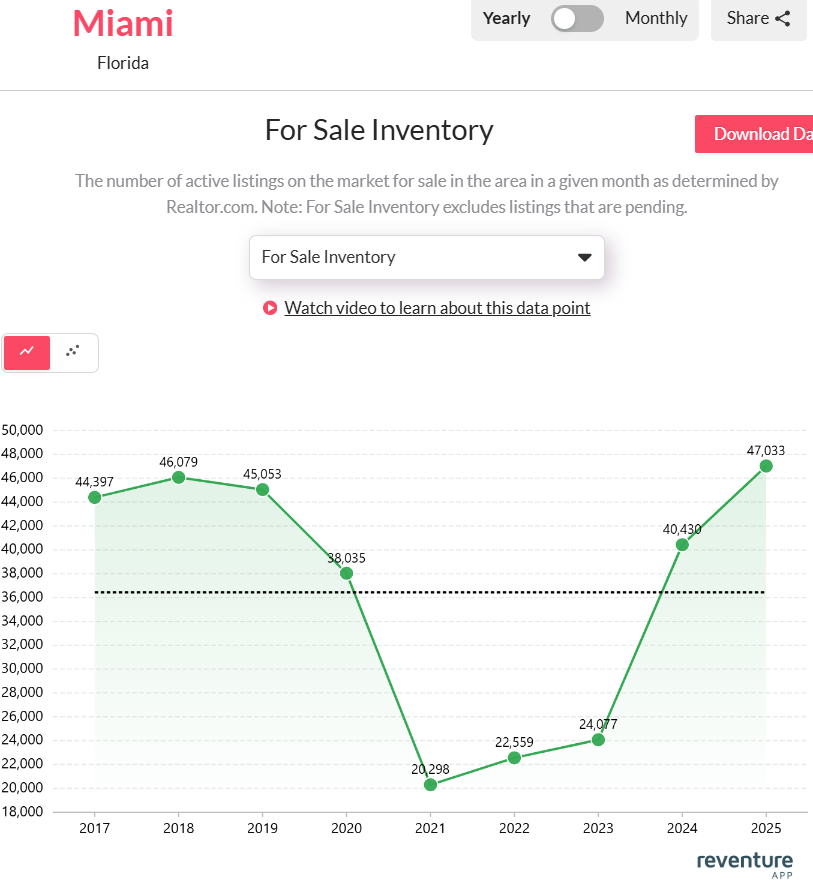
After record lows, Miami’s housing inventory is climbing again, up 16.3% year-over-year in 2025. Access the above graph here. [Link]
While still below pre-COVID norms, this increase signals that sellers are returning to the market faster than buyers can absorb new supply. The surge follows a brief cooling period after inventory spiked 67.9% in 2024, suggesting that pressure has shifted from scarcity to oversupply.
Combined with persistently high home values and rising insurance premiums, this uptick in listings points to weakening demand fundamentals. Historically, when inventory accelerates while affordability remains stretched, price corrections tend to follow. That makes Miami’s current trajectory a textbook warning of bubble risk.
Miami’s Market Dynamics
Miami’s rental market tells another side of the bubble story. One defined by surging costs and shrinking affordability. The typical renter now spends nearly 40% of their income on rent, a sharp climb from the long-term average of around 35%. At the height of 2023’s housing frenzy, this figure peaked at 44.8%, highlighting that runaway prices were squeezing both buyers and renters.
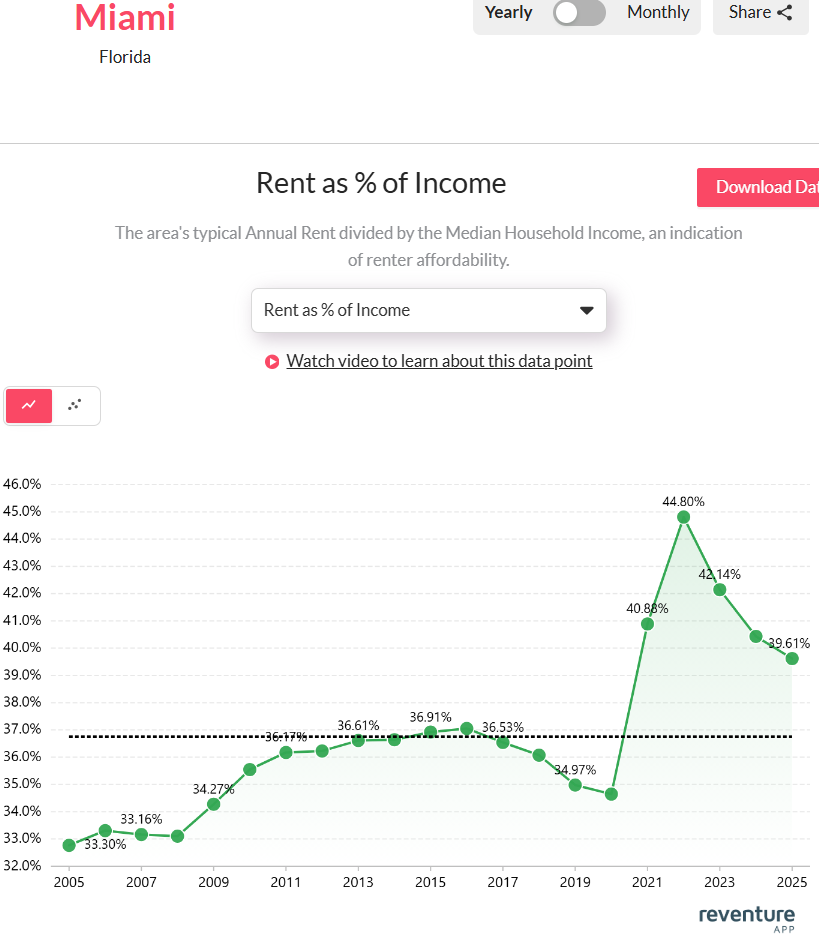
Miami renters now spend nearly 40% of their income on housing, up sharply from pre-pandemic levels. Access the above graph here. [Link]
At the same time, median monthly rents have soared to $2,697 in 2025, up from just $2,122 in 2021, a 27% increase in four years. This surge outpaced income growth, leaving little relief even as home price gains slowed. The combination of rising rents and high ownership costs reflects a broader affordability crisis that residents are caught between unaffordable mortgages and unsustainable leases. Such dual pressure often marks the late phase of a housing cycle, where demand begins to buckle under its own weight.
Final Takeaway
Miami’s market looks strong on the surface, but cracks are showing. Prices are high, inventory is rising, and affordability is slipping fast. The frenzy that once fueled bidding wars is starting to cool. If you’re watching the market, this is the moment to pay attention. The next few months could decide who buys smart and who buys late. Data, not hype, will separate the winners from the rest.
So, get yourself a monthly premium subscription for only $49. It gives you six times more accurate forecasts than Zillow. And you will be able to unlock 40+ data points, from income-to-value ratios to inventory shifts and price projections. For anyone serious about buying in the right place at the right time in Miami or any other metro, that data could make all the difference.
Upgrade to Reventure Premium