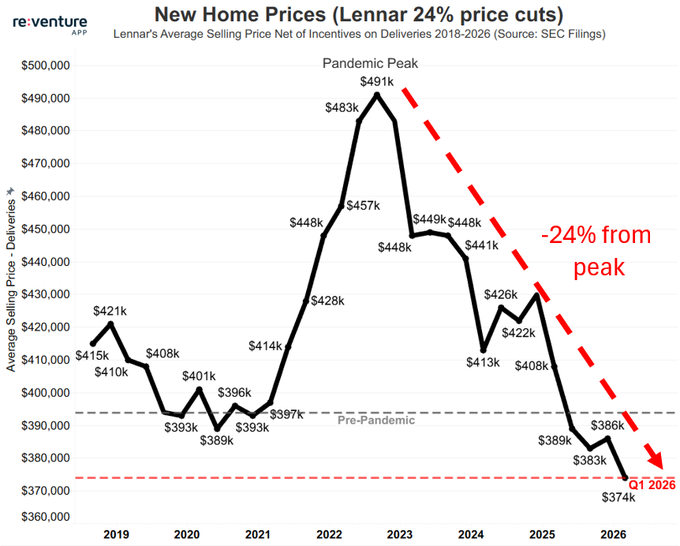
Lennar just did something most of the housing market has been unwilling to do. They cut prices aggressively and openly. The company’s average selling price on new home deliveries peaked at $491,000 in 2022. As of Q1 2026, that number has fallen to roughly $374,000. That is a 24% decline, or more than $110,000 per home when factoring in both outright price reductions and mortgage rate buydowns. Importantly, this is not just a nominal adjustment. The data shows these prices are now below pre-pandemic levels, making this the cheapest new construction pricing environment in nearly a decade.
This matters because Lennar is not a niche builder. They are the second largest homebuilder in the United States, delivering around 80,000 homes per year. When a company of that scale resets pricing this aggressively, it is not just reacting to the market. It is helping define the market. And what Lennar is signaling right now is clear. The era of peak housing prices is over, and the only way to move inventory is through meaningful affordability resets.
Cut Prices Enough, and Buyers Come Back
The most important proof point is not the price cut itself. It is what happened to demand afterward. Lennar’s new orders came in at roughly 18,000 homes in Q1 2026. That figure is essentially flat year over year, but the context is critical. It remains nearly 80% higher than pre-pandemic order volumes. Despite mortgage rates staying elevated and affordability still historically stretched, Lennar is still generating strong sales.
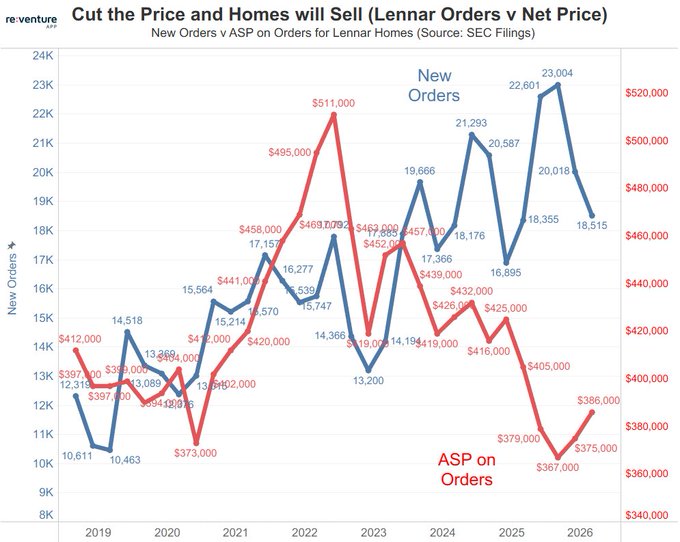
At the same time, the company’s average price on new orders has started to stabilize. After falling sharply from a peak of $511,000 in 2022, new order pricing has risen modestly to about $386,000 over the last two quarters. That is still down 25% from the peak, but the recent upward movement suggests something important. Buyers are responding to the lower price environment. Demand is not gone. It has simply been waiting for prices to reset.
This is the clearest real-time experiment in housing affordability we have seen in this cycle. Lennar is proving that demand destruction was largely a function of price, not a permanent collapse in buyer interest. Once prices fall enough, transactions resume.
A Strategy Built on Volume, Not Margins
What makes Lennar’s approach unique is that it is intentional. They are not slowly marking prices down while hoping conditions improve. They are leaning into the downturn. A significant portion of the price reduction is coming through incentives such as mortgage rate buydowns, which lower monthly payments and make homes more immediately accessible to buyers.
That strategy is allowing Lennar to maintain sales velocity while other builders struggle. It is also driving market share gains. Data from John Burns Research shows Lennar now approaching roughly 12.4% market share, nearly tied with D.R. Horton for the top spot among U.S. homebuilders. That would mark a major shift in industry leadership after years of Horton dominance.
The key tradeoff is profitability. Lennar is choosing to move homes rather than protect peak margins from 2022 and 2023. That decision is not being fully rewarded by the stock market. Over the last five years, Lennar’s stock is up only about 7%, despite massive volatility in the housing cycle. Investors are recognizing that while volume is strong, margins are compressing in a deflationary pricing environment.
Housing Deflation Is No Longer Theoretical
The broader implication is that housing deflation is no longer a forecast. It is happening. And it is starting with builders. Lennar’s pricing reset shows that the fastest-moving participants in the market are already adjusting to new affordability constraints. This is in direct contrast to many existing homeowners, who remain anchored to peak 2022 valuations.
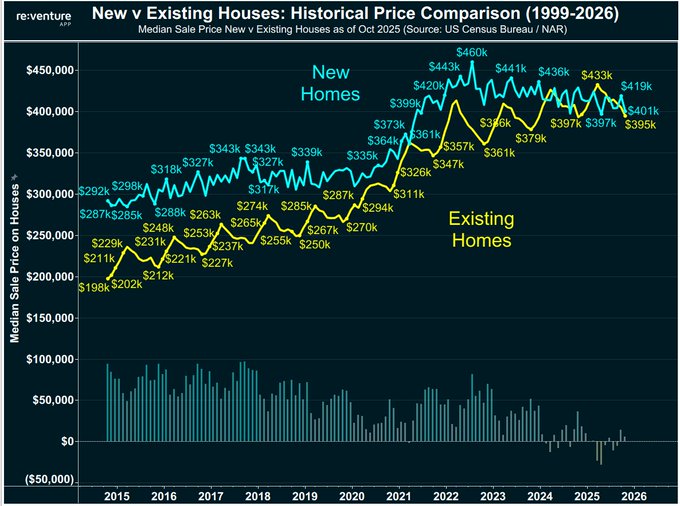
That gap is already beginning to close. There are real-world examples of resale homes trading at significant discounts. Nick Gerli, Reventure’s CEO, just purchased a townhouse in Atlanta, sold at a 35% discount to its 2023 price and a 25% discount to its 2021 price. That is not an isolated anomaly. It reflects a growing willingness among some sellers to meet the market, especially when competing against discounted new construction.
Builders have a structural advantage here. They are motivated sellers with inventory to move and shareholders to answer to. They are not emotionally attached to prior valuations. Existing homeowners, on the other hand, often delay selling to avoid realizing losses. But as more new homes hit the market at lower price points, that resistance becomes harder to maintain.
The Spillover Into Existing Housing Is Coming
A common argument is that this deflation will remain isolated to the builder market. That view is increasingly difficult to defend. Lennar’s actions are already putting pressure on the resale market by offering buyers a better deal on new homes. Lower prices, combined with incentives like rate buydowns, create a compelling alternative to existing homes that still reflect peak-era pricing.
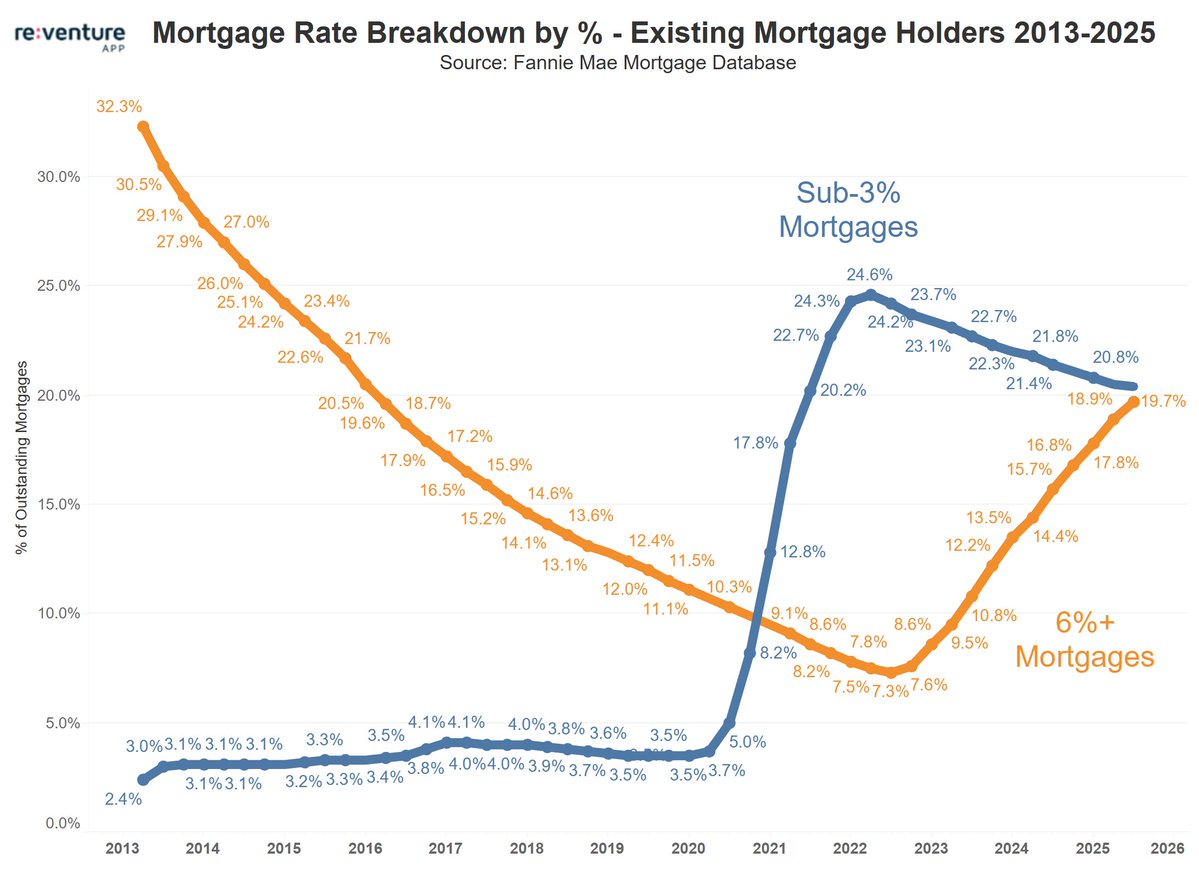
At the same time, macro conditions are shifting. The share of mortgage holders with rates above 6% has now risen above 20%, surpassing the share with sub-3% rates. That is a major change from the dynamic that locked up supply in 2021 through 2023. As more homeowners carry higher-rate mortgages, the financial incentive to hold indefinitely weakens. Over time, this should increase listing activity and put additional pressure on prices.
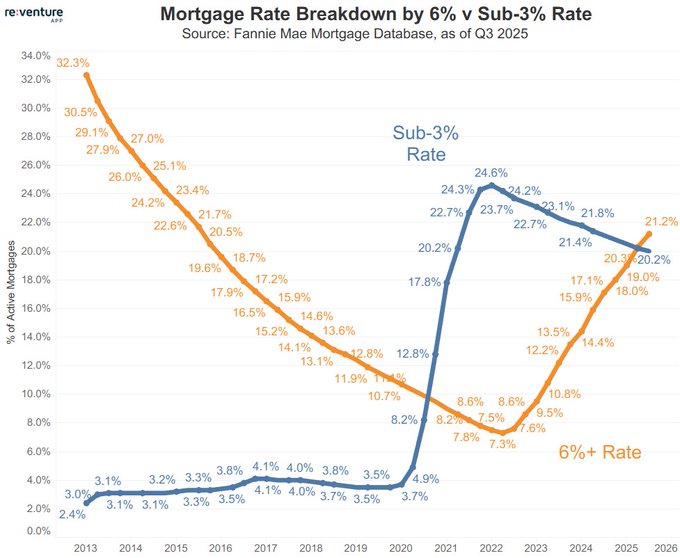
This is how deflation spreads. It does not happen all at once. It starts with the most flexible participants, in this case builders, and gradually moves through the rest of the market as conditions force adjustments.
Track the Reset in Real Time
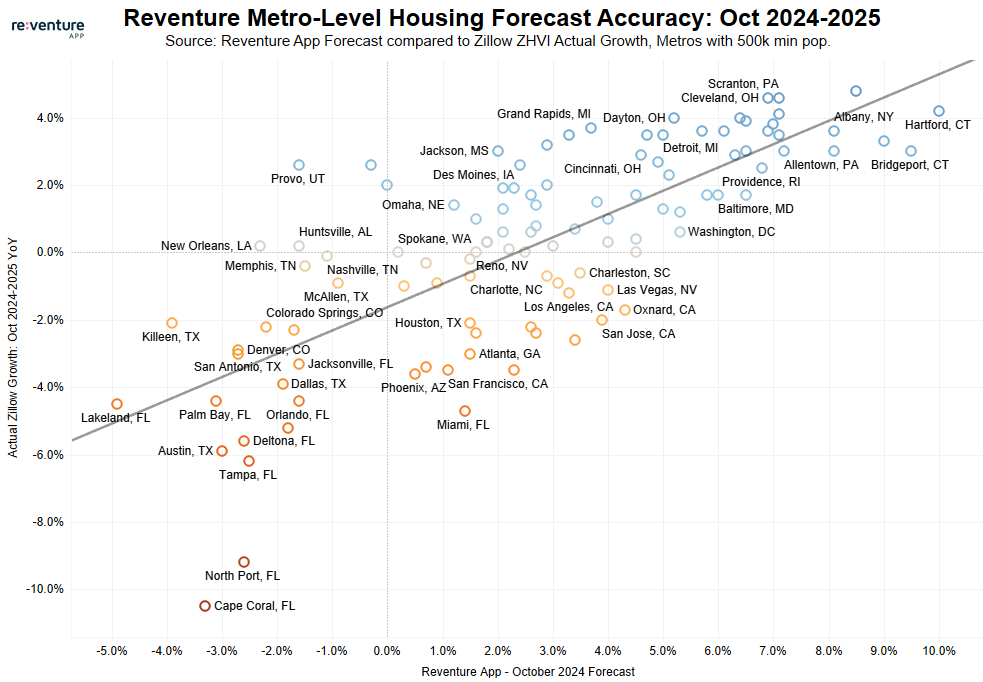
If you want to see where this housing reset is going next, you need to be looking at the data market by market. The reality is that this is not a national story anymore. Some areas are already seeing 20% plus price cuts, rising inventory, and builder-driven deflation. Others are just starting to roll over.
On Reventure App, you can track this in real time, including home price trends, inventory shifts, affordability metrics, and valuation levels relative to historical norms. It shows you exactly which markets are overvalued, which ones are correcting fastest, and where buyers are starting to regain leverage. If Lennar is the leading indicator, Reventure is how you see what comes next.